Evaluating daycare safety standards is the process of reviewing a childcare facility’s licensing compliance, health policies, staff practices, and physical environment to confirm it meets the minimum requirements for safe care and, ideally, exceeds them. Nearly 1 in 5 reported childcare incidents involve preventable injuries such as falls, burns, or choking. That number tells you something critical: a license on the wall does not guarantee a safe environment. The formal industry term for this process is childcare facility assessment, and it combines document review with direct observation. This guide walks you through every layer of that assessment so you can make a confident, informed decision for your child.
What are the baseline daycare safety standards you should expect?
Licensing is the floor, not the ceiling. Every state requires licensed daycare centers to meet minimum standards covering staff-to-child ratios, health and sanitation, building safety, and emergency preparedness. These requirements exist to prevent the most common and serious risks, but they vary significantly by state.
Nearly 30% of licensed daycares exceeded recommended staff-to-child ratios at the time of inspection. That statistic matters because ratio violations directly reduce supervision quality, which is the single biggest driver of preventable injuries in group care settings.

Core licensing requirements to verify
Before you tour any center, request its current license and ask when it was last inspected. Most state licensing agencies publish inspection histories online. The table below summarizes the key checkpoints parents should confirm before enrolling.
| Safety area | What to verify |
|---|---|
| Staff-to-child ratios | Confirm ratios meet or beat state minimums for your child’s age group |
| Health and illness policy | Center should follow CDC fever guidelines requiring exclusion at 100.4°F or higher until symptom-free for 24 hours |
| Emergency preparedness | Ask for written evacuation and lockdown procedures |
| Sanitation practices | Observe handwashing stations, diaper-changing protocols, and surface cleaning routines |
| Background checks | All staff should have cleared state-required criminal background screenings |
Pro Tip: Ask the director to show you the most recent state inspection report before your tour ends. A center confident in its record will hand it over without hesitation.
Licensing is the absolute baseline; true safety comes from exceeding state standards through documented standard operating procedures and continuous staff training. A center that only meets minimums is doing the legal minimum for your child, not the professional one.
- Verify the license is current and posted visibly
- Confirm the center’s illness exclusion policy matches CDC guidelines
- Ask how often staff receive safety training beyond initial onboarding
- Request the last two inspection reports, not just the most recent one
How do you observe real-time safety practices during a daycare tour?
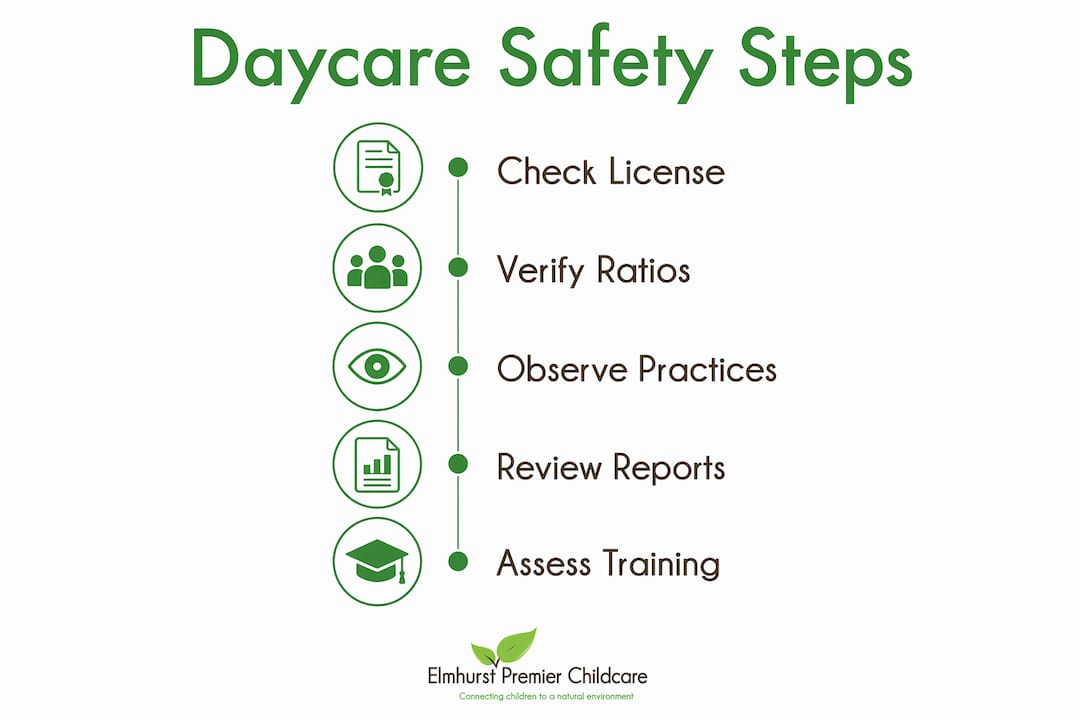
A paper review tells you what a center claims. A visit tells you what it actually does. The most effective way to evaluate a center pairs policy reviews with in-person observations focused on unpredictable moments. Schedule your tour at a busy time, such as arrival, lunch, or outdoor play, not during nap time when the building is quiet and easy to manage.
What to watch during transitions
Transitions between activities are the highest-risk moments in any childcare day. Moving from play to meals, from indoors to outdoors, or from one classroom to another creates brief windows where supervision can break down. Watch whether staff maintain visual contact with every child during these shifts. A teacher who turns their back to the group to manage a door or gather supplies is showing you a gap in their safety culture.
Red flags vs. acceptable minor issues
Not every imperfection is a dealbreaker. Use this framework to sort what you observe:
Red flags that warrant serious concern:
- Staff on phones while supervising children
- Children left unsupervised even briefly in high-risk areas like playgrounds or bathrooms
- Staff speaking harshly or dismissively to children
- Blocked fire exits or unsecured hazardous materials
- No visible sign-in and sign-out procedure at the entrance
Minor issues that are normal and correctable:
- A single toy out of place in a storage area
- A staff member stepping away briefly while another adult remains present
- Slightly delayed response to a minor spill
Pro Tip: Ask staff directly: “What do you do when a child gets hurt?” A confident, specific answer signals a trained team. Vague or hesitant responses signal the opposite.
The in-person observation paired with policy review reveals the true culture of supervision. A center can have a perfect written policy and still have staff who do not follow it. Your eyes during a tour are your most reliable tool.
How do you read and interpret daycare inspection reports?
Inspection reports are public documents, and most parents never read them. That is a missed opportunity. Every licensed childcare center in the United States receives periodic state inspections, and the findings are recorded in detail. Learning to read these reports takes about 15 minutes and can save you from enrolling in a genuinely unsafe facility.
What inspection reports contain
A standard report lists each violation found, the specific regulation it breached, and whether the center corrected it by the follow-up date. Violations are typically categorized by severity, ranging from administrative issues like missing paperwork to serious safety failures like ratio violations or unsecured hazards.
Do not overreact to a single violation. Look for patterns of repeat violations involving supervision or a failure to correct issues promptly. A center cited once for a missing fire drill log is very different from a center cited three times in two years for exceeding child-to-staff ratios.
Violation severity comparison
| Violation type | Severity level | What it signals |
|---|---|---|
| Missing documentation or paperwork | Low | Administrative gap, usually corrected quickly |
| Expired staff certifications | Moderate | Training culture may be weak |
| Ratio violations | High | Direct supervision risk for children |
| Repeated supervision failures | Critical | Systemic problem, not an isolated incident |
| Failure to correct cited issues | Critical | Leadership is unresponsive to safety concerns |
Pro Tip: Search your state’s childcare licensing database by center name before you ever schedule a tour. Illinois parents can use the DCFS Child Care Facility Search tool to pull full inspection histories in minutes.
- Look at the last three inspection cycles, not just the most recent
- Note whether violations were corrected within the required timeframe
- Ask the director directly about any serious violation you find
- A director who explains past issues clearly and describes corrective steps is showing accountability
Repeated violations related to supervision or delayed corrective actions are more critical than isolated administrative issues. A center’s response to a violation tells you as much as the violation itself.
What factors beyond licensing determine overall daycare quality?
Licensing confirms a center meets the legal minimum. Quality is a different measure entirely. Parents assessing child care facilities should look at Quality Rating and Improvement Systems, staff qualifications, the physical environment, and the emotional climate of the classroom.
Quality Rating and Improvement Systems (QRIS)
QRIS provide objective assessments that include educator-child interactions, which basic safety checklists miss entirely. Most states operate a QRIS program that rates centers on a scale, typically 1–5 stars, based on factors like curriculum quality, staff education levels, and family engagement. A center rated at the top tier of its state’s QRIS has been evaluated on dimensions that go well beyond whether the exits are marked.
Staff qualifications and training culture
Effective childcare safety procedures must be documented, routinely trained on, and audited internally to maintain consistent standards. Ask whether the center requires staff to hold credentials beyond state minimums. The Child Development Associate (CDA) credential and the Certified Childcare Professional (CCP) designation both signal a teacher who has invested in professional development. Centers that require these credentials, rather than simply accepting them, set a measurably higher bar.
Elmhurst Premier Childcare, for example, requires every educator to hold an early childhood degree or a related field credential, or to be actively working toward a CDA or CCP certification. That requirement goes beyond what Illinois state licensing mandates.
Physical environment and emotional climate
- Classrooms should be organized to allow clear sightlines for staff supervision
- Outdoor play areas should have age-appropriate equipment with no sharp edges or entrapment hazards
- Children should appear engaged and calm, not anxious or withdrawn
- Staff should use children’s names, get down to their level, and respond warmly to distress
The boutique childcare model supports smaller group sizes, which directly improves supervision quality and allows teachers to build the kind of individual relationships that make children feel secure. Emotional safety and physical safety are not separate categories. A child who feels known and valued by their teacher is more likely to communicate when something feels wrong.
Key Takeaways
Assessing child care facilities requires combining licensing verification, direct observation, inspection report analysis, and quality rating review to build a complete picture of safety and care.
| Point | Details |
|---|---|
| Licensing is the minimum | Verify current licensure, then look for evidence the center exceeds state requirements. |
| Ratios matter most | Nearly 30% of licensed centers exceed recommended ratios; confirm actual ratios during your visit. |
| Observe transitions | Supervision gaps most often appear during activity changes, not during structured classroom time. |
| Read inspection patterns | Repeated violations or slow corrections signal systemic problems, not isolated mistakes. |
| QRIS adds depth | Quality rating systems measure educator-child interactions that standard safety checklists miss entirely. |
What parents get wrong about daycare safety evaluations
Most parents I talk with focus almost entirely on the physical space. They check for outlet covers, look at the playground, and ask about the lock on the front door. Those things matter. But the single biggest predictor of a safe daycare is not the building. It is the people inside it and the culture they operate within.
I have seen centers with beautiful facilities and troubling inspection histories. I have also seen modest spaces run by educators who are genuinely exceptional. The paperwork and the physical environment are your starting point, not your conclusion. The real evaluation happens when you watch a teacher handle a child who is upset, or when you see how staff respond during the chaotic 10 minutes before lunch.
Parents also tend to treat a single inspection violation as disqualifying. That instinct is understandable but often misplaced. What you want to know is whether the center identified the problem, fixed it, and changed its practices. A center that corrects violations quickly and transparently is showing you something important about its leadership.
The hardest part of this process is trusting your gut after you have done the work. If the data looks clean but something felt off during your visit, that feeling deserves weight. You are not being irrational. You are processing dozens of small signals that did not make it onto your checklist. Do both. Review the records carefully, observe the real environment, and then trust the combination of what you found and what you felt.
— Kasindra
Safety and care at Elmhurst Premier Childcare
Elmhurst Premier Childcare holds an active Illinois state license and meets all DCFS health, safety, and ratio requirements. The center goes further by requiring every educator to hold or actively pursue an early childhood degree, CDA, or CCP credential, well beyond what state licensing mandates.
Health and illness policies at Elmhurst Premier Childcare follow CDC guidelines, including the 100.4°F fever exclusion standard, with clear written procedures shared with every family. If you want to see these practices in action, the best next step is a personal visit. Schedule a tour to walk the classrooms, meet the educators, and ask every question on your list. You can also learn more about the preschool program to see how safety and curriculum work together in a structured, nurturing setting.
FAQ
What are the most important daycare safety standards to check?
The most critical standards are staff-to-child ratios, illness exclusion policies, emergency preparedness procedures, and background check requirements for all staff. Verify these against your state’s licensing requirements before enrolling.
How do I find a daycare’s inspection history?
Most states publish childcare inspection records through their licensing agency website. Illinois parents can search the DCFS Child Care Facility Search tool by center name to access full inspection histories at no cost.
What does a fever exclusion policy tell me about a daycare?
A center that follows CDC guidelines requiring children to stay home until fever-free for 24 hours without medication shows it prioritizes group health over enrollment convenience. Weak illness policies are a reliable indicator of broader safety gaps.
How often should a licensed daycare be inspected?
Inspection frequency varies by state, but most states require at least one announced or unannounced inspection per year. Centers with prior violations are typically inspected more frequently as part of corrective oversight.
What is a QRIS and why does it matter for daycare safety?
A Quality Rating and Improvement System (QRIS) is a state-run program that rates childcare centers on a multi-level scale covering curriculum, staff qualifications, and family engagement. QRIS ratings capture educator-child interaction quality that standard licensing inspections do not measure.