
Illinois childcare licensing is defined as the state-mandated approval process that authorizes providers to legally care for children in a group setting. Under the Child Care Act of 1969, any facility serving more than three unrelated children under age 12 must hold a license issued by the Illinois Department of Children and Family Services (DCFS). Operating without one is a Class A misdemeanor. Understanding how childcare licensing works in Illinois gives you a clear framework for evaluating any provider you consider for your child.
How does childcare licensing work in Illinois?
Illinois DCFS issues two primary license types under its regulatory code: one for center-based daycare facilities and one for home-based daycare settings. Both fall under Rules 406 and 407 of the Illinois Administrative Code. The license confirms that a provider meets minimum standards for safety, staffing, training, and facility conditions before a single child walks through the door.
The licensing framework exists because group childcare carries real risk. Young children cannot advocate for themselves, and parents are not present during the day. DCFS licensing creates a legal accountability structure that puts the burden of proof on the provider, not the parent. That is a meaningful protection, and it is worth understanding in detail.
What are the key Illinois childcare licensing standards?
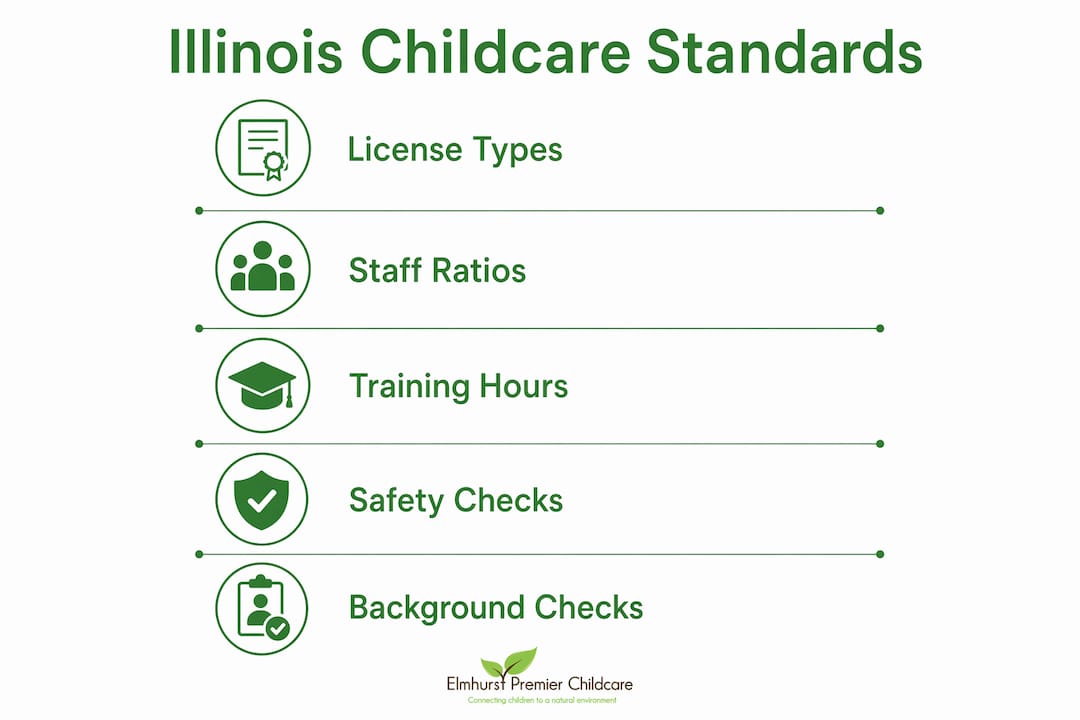
Illinois childcare regulations set specific, measurable requirements across four areas: staff ratios, training, facility safety, and background checks. Meeting all four is non-negotiable for license approval and retention.
Staff-to-child ratios and group size
Staff-to-child ratios are set at 1:4 for infants, 1:5 for toddlers, and 1:12 for preschool-age children. Group size caps apply alongside these ratios. These numbers matter because a caregiver stretched across too many children cannot respond quickly to a fall, a choking incident, or a child in distress. Ratio compliance is one of the first things DCFS inspectors verify.
Annual training and health requirements
Licensed providers must complete at least 15 hours of annual training covering child development, health, safety, and nutrition. That requirement applies to all teaching staff, not just directors. Skipping or underdocumenting training hours is one of the most common causes of violations during inspections.
Facility safety and radon testing
Indoor and outdoor space must meet minimum square footage requirements per child. Safety equipment, including smoke detectors, fire extinguishers, and age-appropriate furniture, must be present and functional. Radon testing is required every three years at licensed centers, and the results must be posted alongside the facility’s license for parents to view.
Background checks for all adults
Background checks including fingerprinting are mandatory for all providers and, in home-based settings, for every adult living in the facility. DCFS runs checks through the Illinois State Police, the FBI, and the state’s child abuse and neglect registry. No adult with a disqualifying record may supervise children.
Pro Tip: When touring a childcare center, ask to see the posted license and the most recent radon test results. Licensed facilities are required to display both. If a provider hesitates, that is a red flag worth taking seriously.
The table below summarizes the core Illinois childcare licensing standards at a glance.
| Standard | Requirement |
|---|---|
| Infant ratio | 1 caregiver per 4 infants |
| Toddler ratio | 1 caregiver per 5 toddlers |
| Preschool ratio | 1 caregiver per 12 children |
| Annual staff training | 15 hours minimum per year |
| Radon testing | Every 3 years, results posted publicly |
| Background checks | Required for all adults in the setting |
How do you obtain a childcare license in Illinois?
The Illinois daycare licensing process follows a defined sequence. Skipping any step delays approval, and the full process typically takes several months from application to opening day. Here is how it works:
-
Submit an application to DCFS. The prospective provider completes the official application and pays the required fee. The application includes details about the facility, proposed capacity, and ownership.
-
Attend a mandatory pre-licensing orientation. DCFS requires all new applicants to complete an orientation session before any inspection is scheduled. This session covers the regulatory requirements and what inspectors will evaluate.
-
Complete background checks. All adults associated with the facility, including owners and staff, must clear fingerprint-based criminal history checks and the child abuse registry before the process moves forward.
-
Prepare documentation. Providers must submit floor plans, health and safety policies, staff qualification records, and emergency procedures. Missing documents are the most common source of delays.
-
Pass a pre-licensing inspection. A DCFS licensing representative visits the facility to verify that it meets all physical and operational standards. If deficiencies are found, the provider must correct them before approval.
-
Receive the license and open legally. Once DCFS confirms compliance, the license is issued. The provider must display it prominently at the facility.
Pro Tip: Start your documentation file the day you decide to apply. Gathering staff credentials, lease agreements, floor plans, and policy manuals takes longer than most applicants expect. A complete file on day one cuts weeks off your timeline.
Common reasons for delays include incomplete applications, failed background checks, and facility deficiencies found during inspection. Providers who open before receiving a license face criminal charges under Illinois law.
How does ongoing compliance and enforcement work after licensing?
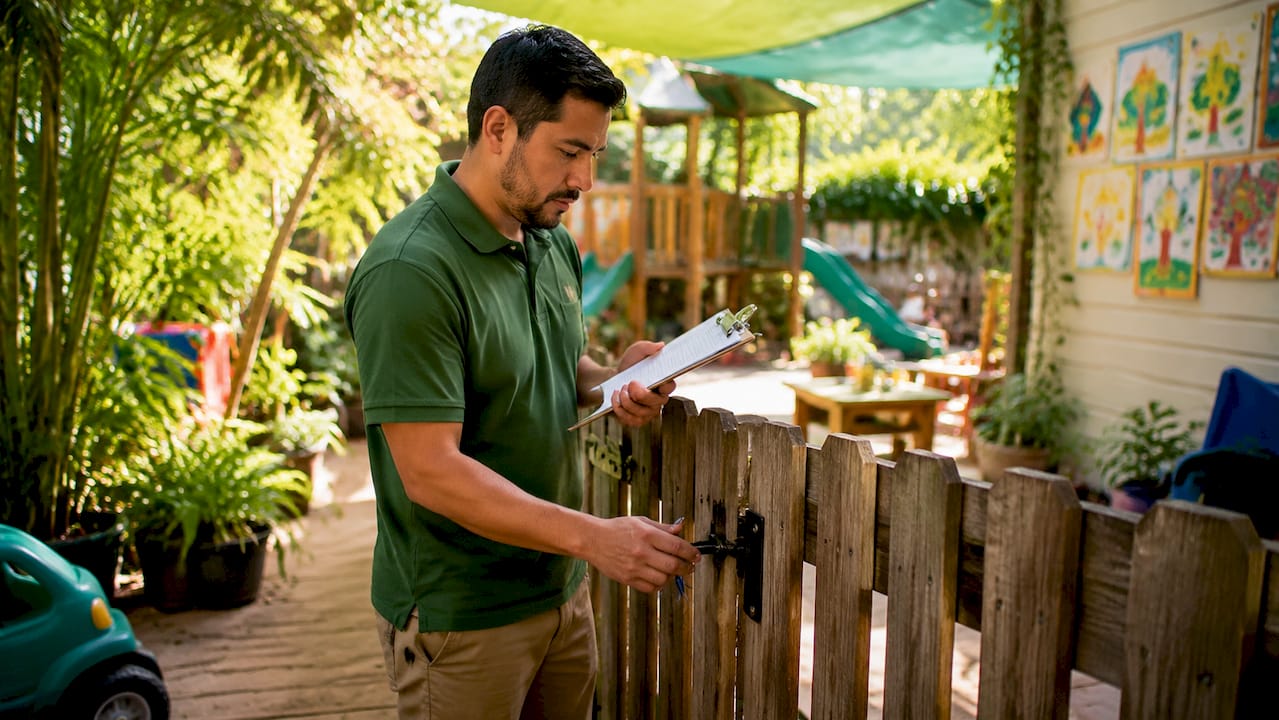
Receiving a license is not the end of the process. DCFS conducts annual announced inspections and may also conduct unannounced visits when a complaint is filed. Both types of inspections carry real consequences for providers who fall short.
During inspections, DCFS evaluates ratio compliance, staff training records, facility safety, and documentation currency. Violations are classified by severity. Minor violations typically result in a corrective action plan with a deadline. Serious or repeated violations can trigger license suspension or full revocation.
- Corrective action plans require the provider to fix specific deficiencies within a set timeframe and submit proof of correction to DCFS.
- License suspension removes the provider’s legal authority to operate while the issue is resolved.
- License revocation permanently ends the provider’s authorization to operate under that license.
- Inspection results and radon reports must be posted at the facility so parents can review them at any time.
- Failure to maintain training hours or background check clearances is a frequent trigger for violations and risks license loss.
Parents have the right to ask about any violation on record. A provider who cannot explain a past violation clearly, or who discourages questions, is not a provider who prioritizes transparency.
DCFS inspection records are not private. Parents can access them directly, which brings us to the most practical part of this guide.
What should parents look for when verifying a provider’s license?
Parents can verify license status, inspection history, and violation records through the official DCFS online portal. This is a free, public resource, and using it before enrolling your child takes less than five minutes.
Here is what to check and what to watch for:
- Active license status. Confirm the license is current and has not lapsed or been suspended. An expired license means the provider is operating illegally.
- Inspection history. Review the dates and outcomes of recent inspections. A pattern of repeated violations in the same category signals a systemic problem, not a one-time mistake.
- Violation context. A single minor violation that was corrected promptly is very different from multiple unresolved violations. Read the details, not just the count.
- Posted license on-site. During any daycare tour, ask to see the physical license displayed at the facility. Providers are required to post it. If it is not visible, ask why.
- Radon test results. These must also be posted. Ask when the last test was conducted and what the results showed.
Pro Tip: Combine the DCFS portal check with a live visit. Online records tell you what happened during scheduled inspections. An in-person visit tells you what the facility looks like on an ordinary Tuesday afternoon.
Licensing sets a legal floor, not a ceiling, for childcare quality. A licensed provider meets minimum safety standards. A high-quality provider goes further by maintaining lower ratios than required, hiring staff with formal early childhood education credentials, and offering a structured curriculum. When you evaluate daycare safety standards, ask about staff qualifications beyond the state minimum, the curriculum approach, and how the center communicates with families daily.
Key Takeaways
Illinois childcare licensing requires DCFS approval before any provider can legally care for more than three unrelated children under age 12, and a license confirms minimum safety, staffing, and training standards are met.
| Point | Details |
|---|---|
| Legal requirement | Any provider serving more than 3 unrelated children under 12 must hold a DCFS license. |
| Core standards | Ratios, 15 hours of annual training, radon testing, and background checks are all mandatory. |
| Application timeline | The licensing process typically takes several months from application to approval. |
| Ongoing enforcement | DCFS inspects annually and may visit unannounced; violations can result in suspension or revocation. |
| Parent verification | Use the DCFS online portal to check license status and inspection history before enrolling. |
What licensing data actually tells you as a parent
I have spent a lot of time reviewing childcare licensing information with families, and the most common mistake I see is treating a valid license as a green light. It is not. A license tells you a provider cleared a baseline check on a specific day. It does not tell you what the classroom looks like at 2 p.m. on a Wednesday, how staff talk to children when they are frustrated, or whether the director knows each child by name.
The DCFS portal is genuinely useful, but inspection records reflect a snapshot, not a continuous picture. Most inspections are announced in advance, which means providers have time to prepare. That is not a flaw in the system so much as a reality parents should factor into their evaluation. Use the portal, but do not stop there.
The questions that reveal the most about a childcare center are rarely on any checklist. Ask how staff handle a child who is having a hard day. Ask what the turnover rate is among teachers. Ask whether the director can tell you something specific about a child who has been enrolled for six months. Those answers tell you far more than a compliance report.
Licensing is the starting point. Your judgment, your observations, and your instincts are what complete the picture.
— Kasindra
Elmhurst Premier Childcare goes beyond the licensing baseline
Illinois licensing sets the floor. Elmhurst Premier Childcare builds well above it.
Every educator at Elmhurst Premier Childcare holds an early childhood degree or is actively earning a Child Development Associate (CDA) or Certified Childcare Professional (CCP) credential. That requirement goes beyond what DCFS mandates. The center’s STEAM curriculum is built on hands-on, play-based learning that supports kindergarten readiness at each child’s own pace. Families also have access to parent resources that help them understand childcare quality, ask the right questions, and stay connected to their child’s daily experience. If you want to see what licensed childcare looks like when a provider genuinely exceeds the standard, a tour of Elmhurst Premier Childcare is the clearest answer.
FAQ
Do I need a childcare license in Illinois?
Yes. Any provider caring for more than three unrelated children under age 12 must hold a DCFS license under the Child Care Act of 1969. Operating without one is a Class A misdemeanor.
What are the staff-to-child ratios required in Illinois?
Illinois requires a 1:4 ratio for infants, 1:5 for toddlers, and 1:12 for preschool-age children. Group size caps also apply alongside these ratios.
How long does it take to get a childcare license in Illinois?
The Illinois daycare licensing process typically takes several months from application submission to final approval, depending on documentation completeness and inspection outcomes.
How can I check if a childcare provider is licensed in Illinois?
Parents can verify a provider’s license status, inspection history, and violation records for free through the official DCFS online portal at dcfs.illinois.gov.
Is a licensed childcare center automatically a high-quality center?
No. A license confirms a provider meets minimum state standards. High-quality centers go further by maintaining lower ratios, hiring credentialed staff, and offering enriched curricula beyond what licensing requires.