
A quality childcare center is defined by low caregiver-to-child ratios, warm and responsive caregiving, safe physical environments, and structured developmental programs. These are not preferences. They are measurable indicators that directly shape your child’s safety, attachment, and growth. Knowing the signs of a quality childcare center before you tour gives you a clear framework for comparison. Industry standards from NAEYC (National Association for the Education of Young Children) and research on early childhood development point to the same core criteria: who cares for your child, how they do it, and what surrounds your child every day.
What are the signs of a quality childcare center?
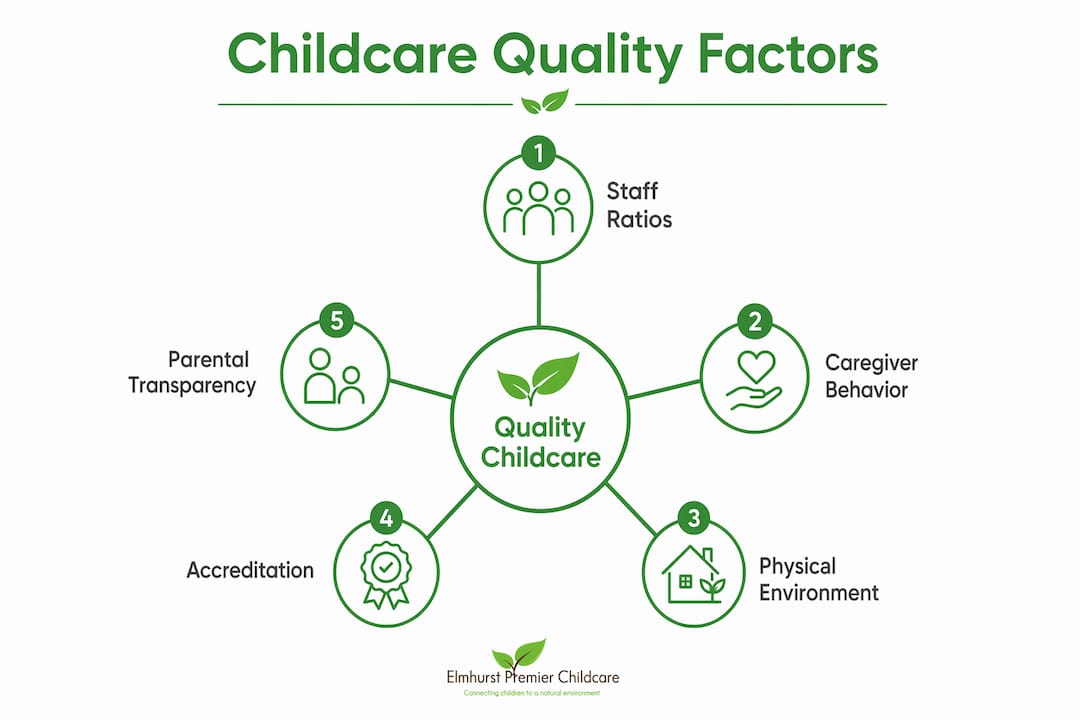
The most reliable signs of a quality childcare center fall into four categories: staffing ratios, caregiver behavior, physical environment, and program credentials. Each category gives you a different window into how a center actually operates, not just how it presents during a scheduled tour.
Caregiver-to-child ratios are the single most objective measure you can check on day one. NAEYC recommends a maximum ratio of 1:4 for infants, with 1:3 preferred for optimal safety and responsiveness. A lower ratio means each caregiver has fewer children to monitor, which directly increases how quickly your baby’s needs get met. Centers that exceed these ratios cannot realistically provide the individual attention infants require.

Caregiver behavior is harder to quantify but equally important. Responsive interactions, including eye-level communication, prompt comforting, and knowing each child by name, predict positive developmental outcomes more reliably than facility features alone. A beautiful building with inattentive staff is not a quality program.
How do caregiver-to-child ratios affect your infant’s care?
Ratios determine how much individual attention your child receives every hour of the day. When a caregiver is responsible for too many infants at once, response times slow, safety risks increase, and the emotional connection that drives healthy development gets stretched thin.
For infants under 12 months, the recommended ratio is no greater than 1:4, with 1:3 considered the gold standard. For toddlers aged 1–2, NAEYC recommends no more than 1:4 to 1:6 depending on group size. These numbers exist because research consistently links lower ratios to faster caregiver response, more verbal interaction, and stronger attachment outcomes.
When evaluating a center, ask these specific questions:
- What is the ratio in the infant room right now, not just on paper?
- Does the ratio change during nap time or shift changes?
- How does the center handle ratio coverage when a staff member calls in sick?
- Is the posted ratio the average or the guaranteed maximum?
Centers that cannot answer these questions clearly are telling you something. Transparency about ratios is itself a quality indicator.
How do caregiver interactions reveal childcare quality?
Caregiver behavior is the most powerful predictor of your child’s experience. Warm, responsive interactions matter more than square footage, equipment, or even accreditation status. What you observe in the first 10 minutes of a visit tells you more than any brochure.
The primary caregiver model is a key structural sign. Consistent caregiver assignment for a baby’s core daily needs, such as feeding, diapering, and comforting, supports secure attachment and reduces the developmental risk that comes with rotating caregivers. Centers that rotate staff randomly through infant rooms prioritize scheduling convenience over child development.
Watch for these specific behaviors during your visit:
- Caregivers get down to the child’s level when speaking or playing
- Infants are held and comforted promptly when distressed
- Staff use each child’s name and respond to individual cues
- Caregivers narrate what they are doing during diapering or feeding
Pro Tip: Visit during a feeding or diapering time, not just during structured play. Routine care moments reveal the most about how caregivers actually interact with infants when no one is watching.
The role of play-based learning also shows up in how caregivers engage during free play. Staff who sit on the floor, follow the child’s lead, and narrate play are practicing developmentally appropriate interaction, not just supervision.
What does the physical environment tell you about a childcare center?
A well-designed infant room signals that a center prioritizes active development over passive supervision. Dedicated floor space for crawling and tummy time, age-appropriate toys within reach, and clear sightlines for caregivers are all physical signs of intentional program design.
Safety and cleanliness are non-negotiable baselines. Sleeping arrangements should follow American Academy of Pediatrics (AAP) guidelines: firm, flat surfaces with no loose bedding, and infants placed on their backs. Diapering areas should be sanitized between each use. Toys should be cleaned regularly and inspected for broken parts.
A strong physical environment includes:
| Feature | What to look for |
|---|---|
| Sleeping area | Firm, flat cribs; no soft bedding; individual sleep spaces |
| Play space | Open floor area for crawling; low shelves with reachable toys |
| Outdoor access | Safe, fenced outdoor area used daily weather permitting |
| Cleanliness | Sanitized surfaces, clean diapering stations, no strong chemical odors |
| Safety features | Covered outlets, secured furniture, gated stairs, locked cabinets |
Daily routines matter as much as the physical setup. Quality centers follow structured but flexible schedules that honor each infant’s individual feeding and sleep patterns rather than forcing all children onto one timetable. A center that insists every infant naps at the same time is prioritizing staff convenience, not child development.
What does NAEYC accreditation mean for childcare quality?
NAEYC accreditation is the most recognized quality credential in American early childhood education. Only about 8% of U.S. childcare centers hold this accreditation, which signals that a program meets advanced standards beyond state licensing in curriculum, staff qualifications, and family partnerships. The process takes 12–18 months and involves rigorous self-study and external evaluation.
Accreditation carries a real cost. The process runs $1,500–$5,000 in fees alone, not counting the staff time required. NAEYC-accredited centers often charge a 15–30% tuition premium to offset higher operational costs. That premium reflects better staff qualifications and lower ratios, but it also puts accreditation out of reach for some families.
Pro Tip: Accreditation is a strong signal, but it is not the only one. Ask any center, accredited or not, about staff turnover rate, teacher credentials, and how they handle parent communication. Those answers reveal daily quality more than a certificate on the wall.
Many high-quality independent centers skip NAEYC accreditation due to cost and administrative burden but maintain low staff turnover and transparent communication as quality signals. Elmhurst Premier Childcare, for example, requires every educator to hold an early childhood degree or earn a Child Development Associate (CDA) or Certified Childcare Professional (CCP) credential, going beyond state minimums without relying on accreditation as the sole quality marker.
What are the red flags in a daycare you should never ignore?
Red flags in a daycare are often visible within the first visit if you know what to look for. The most serious warning signs involve children, not facilities. A child who is persistently distressed well beyond the normal adjustment window is the clearest signal that something is wrong.
A 2–4 week adjustment period is normal for infants and toddlers starting a new center. Persistent distress, sleep disruptions, eating changes, or unexplained physical marks after that window require immediate follow-up. These are not signs of a slow adjustment. They are signs of a placement that may not be working.
Staff and environment red flags include:
- High staff turnover or unfamiliar faces every few weeks
- Caregivers on phones or disengaged during child supervision
- Children left crying without response for extended periods
- Reluctance to allow unannounced parent visits
- Vague or defensive answers to direct questions about ratios and credentials
Unannounced visits are one of the most effective tools a parent has. A center that discourages drop-in visits is hiding its daily operational reality. A center that welcomes them is confident in what you will find.
“A center that manages to appear well-run only during scheduled visits likely lacks daily operational quality.” — Parent evaluation research
Use the daycare tour questions guide to build a list of specific questions before your first visit. Going in prepared makes it much harder for a center to deflect with polished talking points.
Key Takeaways
A quality childcare center is identified by low caregiver-to-child ratios, warm and responsive staff, a safe and developmentally appropriate environment, and transparent communication with families.
| Point | Details |
|---|---|
| Caregiver ratios matter most | NAEYC recommends no greater than 1:4 for infants; lower ratios mean more individual attention. |
| Responsive caregiving predicts outcomes | Staff who use children’s names, comfort promptly, and engage at eye level drive better development than facility features alone. |
| Physical environment signals intent | Dedicated crawling space, AAP-compliant sleep areas, and clean surfaces show a center designed for development, not just supervision. |
| Accreditation is valuable but not the only signal | Only 8% of U.S. centers hold NAEYC accreditation; strong credentials, low turnover, and open communication matter equally. |
| Unannounced visits reveal true quality | A center that welcomes drop-in visits is confident in its daily operations; reluctance is a red flag. |
What I’ve learned from watching parents evaluate childcare
Parents consistently underestimate how much they can learn in the first five minutes of a visit. You do not need a checklist to feel that something is off. You need permission to trust that feeling and then verify it with specific questions.
The research on caregiver responsiveness confirms what most parents sense intuitively. Relational quality and responsive interactions are the most impactful quality markers in early childhood settings. A center with a beautiful curriculum binder and inattentive staff is not a quality program. A center with engaged, warm caregivers and a modest facility often outperforms it.
The unannounced visit is the single most underused parent tool. Unexpected visits verify whether what you saw on the tour is what actually happens every Tuesday at 10 a.m. I have seen parents tour a center, feel good about it, and then drop in a week after enrollment to find a completely different atmosphere. That gap between tour and reality is the most important thing to close before you commit.
Credentials matter. Ratios matter. But the question I always come back to is simple: does your child seem genuinely happy and settled after the adjustment period? That answer, combined with the research-backed indicators in this article, gives you the full picture.
— Kasindra
Elmhurst Premier Childcare: where these standards are the baseline
Every quality indicator in this article describes what Elmhurst Premier Childcare builds into its program by design, not as an aspiration.
Elmhurst Premier Childcare maintains low caregiver-to-child ratios, requires every educator to hold an early childhood degree or earn a CDA or CCP credential, and operates on a hands-on STEAM curriculum built for developmentally appropriate learning. Fresh, nutritious meals, daily family updates, and a Parent Committee keep families genuinely connected. As a locally owned boutique school, every decision is made in Elmhurst, for the children and families here. If you are ready to see these standards in action, schedule a tour or explore the preschool program to learn more.
FAQ
What is the ideal caregiver-to-infant ratio in a quality center?
NAEYC recommends a maximum ratio of 1:4 for infants, with 1:3 preferred for the best safety and responsiveness. Centers that exceed this ratio cannot reliably meet each infant’s individual needs.
How do I know if a childcare center exceeds state standards?
Ask whether teachers hold early childhood degrees or credentials like the CDA or CCP, and request the center’s actual caregiver-to-child ratios. Centers that go beyond state minimums on both counts consistently deliver higher quality care.
What are the biggest red flags in a daycare?
High staff turnover, reluctance to allow unannounced visits, and persistent child distress beyond the normal 2–4 week adjustment period are the most serious warning signs. Any of these warrants immediate follow-up or reconsideration of the placement.
Does NAEYC accreditation guarantee better care?
NAEYC accreditation signals that a center meets advanced standards, but only about 8% of U.S. centers hold it. Strong teacher credentials, low turnover, and transparent parent communication are equally reliable quality indicators in non-accredited centers.
What questions should I ask during a childcare center tour?
Ask about the current ratio in the infant room, how ratios are covered during staff absences, teacher credential requirements, and whether unannounced parent visits are permitted. A center that answers these questions directly and confidently is demonstrating the transparency that defines quality care.