Peer learning in early childhood is defined as a process where young children build cognitive, language, and social skills by actively helping, teaching, and collaborating with each other under guided conditions. This is the standard term educators use, though you may also hear it called collaborative learning or peer-assisted learning in preschool and early education settings. Research confirms that both the child doing the teaching and the child receiving help gain measurable benefits. For parents and educators in Elmhurst and beyond, understanding what peer learning is and how it works gives you a concrete tool for supporting children’s development every single day.
What is peer learning in early childhood settings?
Peer learning is structured interaction where one child helps another practice, explain, or apply a skill. It is not free play, and it is not simply putting children next to each other and hoping something educational happens. The Education Endowment Foundation describes peer tutoring as a specific learning process where one peer manages content for another to learn, with clear benefits for both roles.
The critical word here is “guided.” Without adult structure, peer interaction tends to drift into social play rather than learning. When an educator sets a goal, assigns a role, and gives children a prompt to work from, the interaction becomes genuinely educational. That distinction separates peer learning from casual group time.
Two roles appear consistently in peer learning research: the tutor and the tutee. The tutor explains or demonstrates; the tutee practices and asks questions. What makes early childhood peer learning especially powerful is that these roles can switch. A child who struggles with counting may be an excellent explainer when it comes to color sorting. That flexibility builds confidence across the board.
How does peer learning work in a classroom?
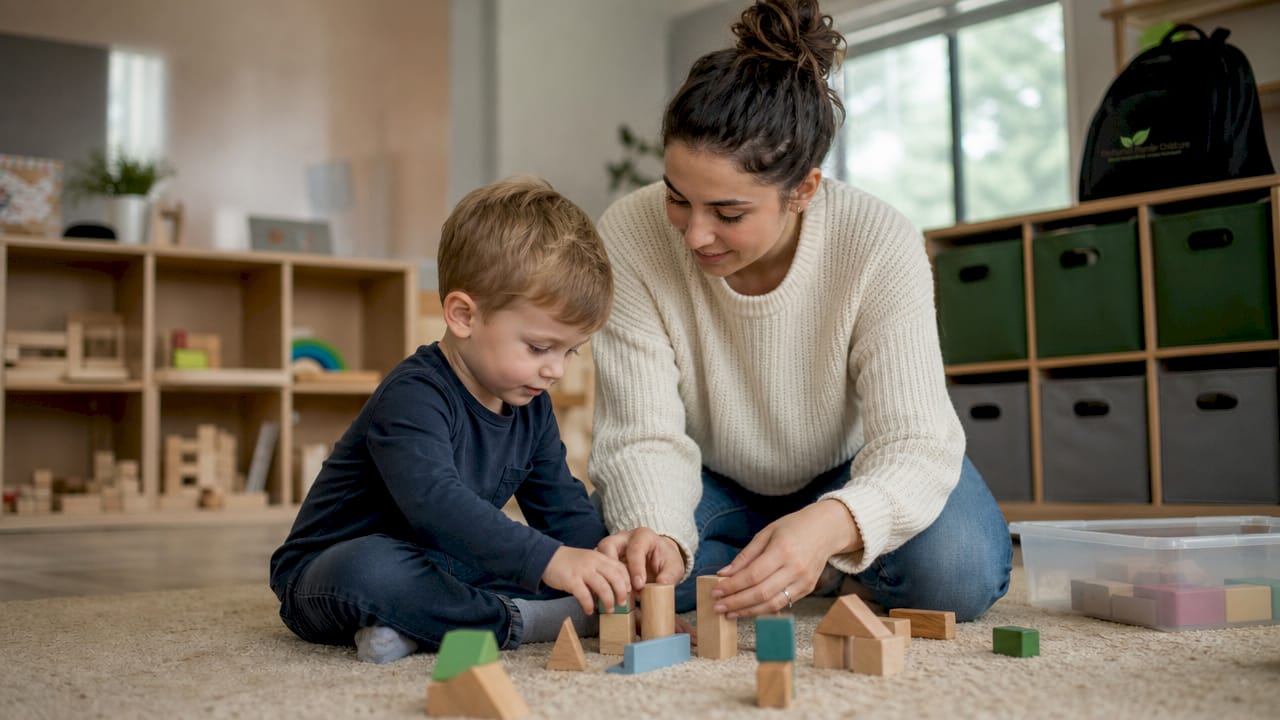
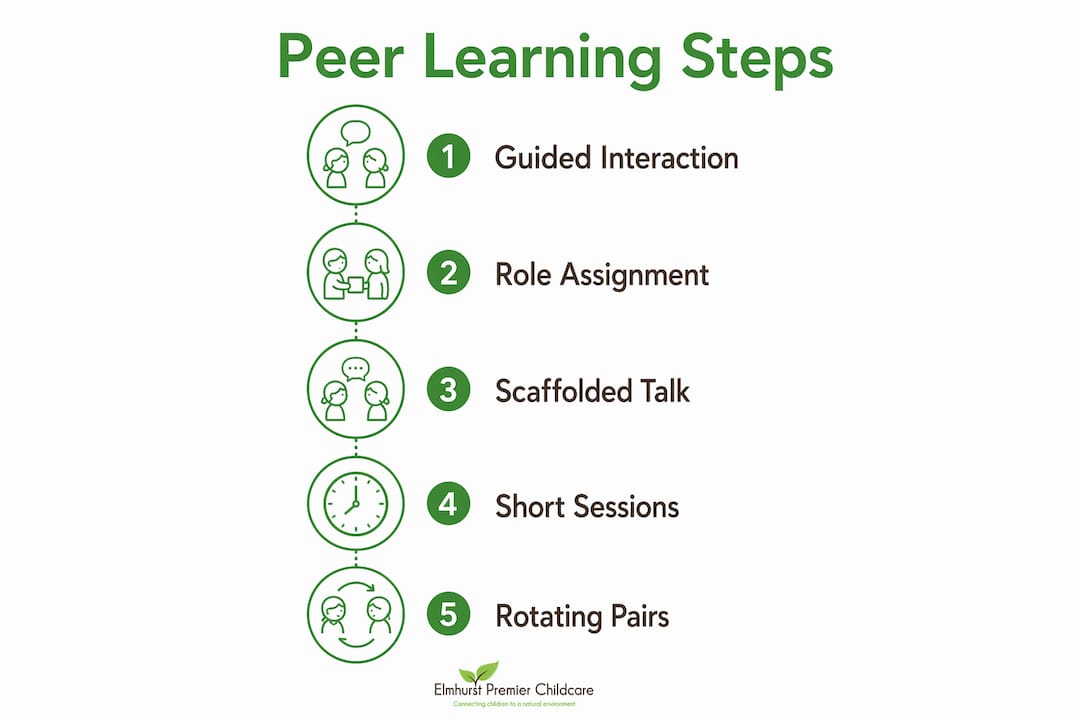
Peer learning follows a predictable sequence that any educator or parent can recognize and replicate.
- Adult modeling. The teacher demonstrates the skill first. Children watch and listen before any peer interaction begins. This step is non-negotiable. Adult demonstration followed by peer practice aligns with the strongest evidence on peer learning impact in early childhood.
- Role assignment. The educator pairs children and assigns clear roles. One child is the explainer; the other is the practitioner. Roles are defined before the activity starts, not discovered mid-task.
- Scripted prompts. Adults give children specific language to use. A prompt like “Tell me how you got that answer” is far more productive than “Help your friend.” Micro-roles and scripted prompts are what allow very young children to give real feedback rather than just watch each other.
- Guided practice. Children work together while the adult circulates, listens, and intervenes only when the interaction stalls. The goal is productive struggle, not rescue.
- Reflection. The session ends with a brief group check-in. What did you figure out? What was hard? This step cements the learning and gives the educator data for the next cycle.
A 2025 study tracking children through a six-week math unit found that small group peer talk, combined with teacher scaffolding, enabled children to solve problems they could not solve alone. That finding matters because it shows peer learning is not just social enrichment. It produces measurable cognitive gains.
Pro Tip: Keep peer learning sessions short. For preschoolers, 10–15 minutes of structured peer interaction is more productive than 30 minutes of loosely supervised group work.
What are the benefits of peer learning for young children?
The benefits of peer learning span three domains: cognitive development, language growth, and social-emotional skills. Each one reinforces the others.
- Academic gains. The Education Endowment Foundation reports that peer tutoring delivers average positive learning effects equivalent to about six additional months of progress within one academic year. That is a significant return for a relatively low-cost classroom practice.
- Language development. A study implementing peer tutor strategies in writing activities found that language development scores increased from 2.30 to 3.07 across iterative learning cycles in kindergarten children. Children who explain ideas out loud consolidate their own understanding while building vocabulary.
- Reasoning and problem-solving. A 10-month playgroup intervention showed that peer interaction produced significant gains in reasoning scores and visual-spatial problem-solving in children under four, compared to children without structured peer contact.
- Social skills and empathy. Children practicing peer learning learn to listen, take turns, and adjust their explanations when a peer does not understand. These are the exact social skills that predict kindergarten readiness and long-term school success.
- Self-confidence. Being the “explainer” gives young children a sense of competence. That experience of being genuinely helpful to another person builds self-worth in a way that adult praise alone cannot replicate.
“Peer interaction in early childhood is not a supplement to learning. It is a core mechanism through which young children develop the cognitive and social tools they will use for the rest of their lives.” — Education research consensus across the Education Endowment Foundation and early childhood development literature.
The benefits flow in both directions. The child acting as tutor must organize their thinking clearly enough to explain it. That act of explanation deepens their own understanding more than passive review ever could.
What are effective peer learning strategies for early childhood?
Knowing the benefits is one thing. Knowing how to apply peer learning strategies in a real classroom or home setting is another. The table below compares three common approaches.
| Strategy | Best for | Key adult role |
|---|---|---|
| Paired reading | Language and literacy reinforcement | Assign roles; provide sentence starters |
| Math talk partners | Number sense and counting review | Model the target language first; circulate and prompt |
| Reciprocal teaching | Comprehension and storytelling | Rotate explainer and listener roles each session |
All three strategies share one requirement: peer learning works best as a review tool, not an introduction to new content. Peer tutoring is most effective when children are consolidating skills they have already encountered through direct instruction. Sending two children to “figure it out together” before either has a foundation produces frustration, not learning.
Program format also matters. Short cycles of four to six sessions, each building on the last, outperform one-off activities. Longitudinal observations of early years classrooms show that peer talk evolves and deepens across repeated sessions when teacher scaffolding is consistent. Children get better at explaining, questioning, and correcting each other over time.
Pro Tip: Rotate pairs regularly. Children benefit from explaining to different peers, not just their best friends. Different partners surface different gaps and strengths.
How does peer learning differ from peer teaching?
Peer learning and peer teaching are related but not identical. Understanding the difference helps educators choose the right approach for the right goal.
Peer teaching is a structured arrangement where one child takes on an explicit instructional role, delivering content and assessing whether the other child has understood. The roles are fixed, the intent is instructional, and the structure is formal relative to other forms of peer interaction.
Peer learning is broader. It includes any collaborative interaction where children learn from and with each other, including discussion, joint problem-solving, and shared exploration. The roles are more fluid, and the learning is often mutual rather than directional.
Key distinctions that matter in practice:
- Peer teaching requires one child to have a stronger grasp of the content. Peer learning can work even when both children are at similar levels.
- Peer teaching is more appropriate for reviewing discrete skills. Peer learning suits open-ended tasks like building, storytelling, or science exploration.
- Peer teaching demands tighter adult structure. Peer learning can tolerate more child-led direction once children have practiced the format.
Neither approach is superior. The best early childhood classrooms use both, matching the format to the learning goal. A math counting activity benefits from structured peer teaching. A block-building challenge benefits from open collaborative learning.
Key Takeaways
Peer learning in early childhood is most effective when adults provide clear roles, scripted prompts, and consistent scaffolding across repeated short sessions that reinforce already-introduced skills.
| Point | Details |
|---|---|
| Define peer learning clearly | Peer learning is guided collaboration, not free play. Adult structure is what makes it educational. |
| Use it as a review tool | Introduce skills through direct instruction first, then use peer interaction to consolidate them. |
| Both roles benefit | The child explaining a concept deepens their own understanding as much as the child receiving help. |
| Short cycles work best | Four to six structured sessions build on each other and produce measurable gains over time. |
| Peer learning and peer teaching differ | Peer teaching uses fixed roles for instruction. Peer learning is broader and more fluid in structure. |
What I have learned from watching peer learning in action
The biggest mistake educators and parents make with peer learning is confusing proximity with collaboration. Putting two children at the same table is not peer learning. What transforms that moment into genuine learning is the adult work that happens before the children sit down together.
I have seen classrooms where peer learning is treated as a break for the teacher. The children chat, drift, and occasionally help each other by accident. I have also seen classrooms where a teacher spends five minutes modeling a prompt, assigns clear roles, and then steps back. The difference in what children produce is striking. The second group is not smarter. They are just better supported.
The other thing I would push back on is the idea that peer learning is only for older children. The research on playgroups and early peer interaction shows that children under four make real cognitive gains from structured peer contact. The key is matching the complexity of the task to the developmental stage. A three-year-old cannot deliver a lecture, but they can tell a partner what color block comes next. That is peer learning. It counts.
Parents often ask whether they can support peer learning at home. The answer is yes, and it does not require a classroom. Arrange playdates with a specific activity and a simple role. Ask your child to “teach” a younger sibling one thing they learned that week. The act of explaining, even imperfectly, builds the same cognitive muscles that structured classroom peer learning builds.
— Kasindra
How Elmhurst Premier Childcare builds peer learning into every day
Elmhurst Premier Childcare integrates peer learning into its daily program through intentional small-group activities, paired tasks, and a STEAM curriculum designed for hands-on collaboration. Every educator at Elmhurst Premier Childcare holds an early childhood degree or a Child Development Associate credential, which means they know how to structure peer interactions that actually produce learning rather than just group time. The preschool program and Pre-K program both use structured peer activities to build kindergarten readiness across language, math, and social development. Families who want to see this approach in person are welcome to book a tour and watch a session firsthand.
FAQ
What is peer learning in early childhood?
Peer learning in early childhood is a guided process where young children learn cognitive, language, and social skills by helping and collaborating with each other under adult-structured conditions. It differs from free play because it requires defined roles, clear goals, and adult scaffolding.
How does peer tutoring benefit both children?
The child acting as tutor deepens their own understanding by organizing and explaining content. The child receiving help gets individualized practice and feedback, with research showing gains equivalent to about six additional months of learning progress in one year.
At what age can children start peer learning?
Children under four benefit from structured peer interaction. A 10-month playgroup study found significant gains in reasoning and visual-spatial skills in children who had guided peer contact compared to those who did not.
What is the difference between peer learning and peer teaching?
Peer teaching uses fixed roles where one child explicitly instructs another. Peer learning is broader and includes any collaborative interaction where children learn from each other, with roles that can shift depending on the task and the children involved.
How can parents support peer learning at home?
Parents can support collaborative learning by arranging structured playdates with a specific activity, asking children to teach a sibling one new thing, or using simple role prompts during play. The structure does not need to be formal. It just needs a clear goal and a defined role for each child. You can find additional guidance through parent resources designed for families supporting early learning at home.