Early childhood education (ECE) is defined as intentional learning and care that supports a child’s cognitive, social, emotional, language, and physical growth from birth through age 8. Understanding early childhood education gives you the knowledge to make better decisions for your child, from choosing the right program to supporting development at home. More than 80% of brain development occurs before age 5. That single fact explains why the early years are not just a warm-up for school. They are the foundation for everything that follows.
What is understanding early childhood education, and why does it matter?
ECE is not simply childcare. ECE is intentional learning that promotes cognitive, social-emotional, language, and physical growth across the full birth-to-age-8 window. The distinction matters because parents who treat early learning as mere supervision miss the window when the brain is most receptive to new skills and relationships.
The OECD describes quality ECE as a long-term investment in lifelong well-being, emotional stability, and social cohesion. That framing shifts the conversation from “keeping kids safe” to “building the person your child will become.” Children who attend two years of quality ECE show measurably stronger language, number concepts, independence, and social skills when they start school. One year helps. Two years helps more, especially for children who need extra support.

UNICEF and the OECD both point to trained educators, play-based curriculum, and family partnerships as the three pillars of quality programs. Elmhurst Premier Childcare builds its entire model around these pillars, requiring every educator to hold an early childhood degree or earn a Child Development Associate (CDA) or Certified Childcare Professional (CCP) credential. That standard goes well beyond what Illinois state minimums require.
What are the key developmental domains in early childhood?
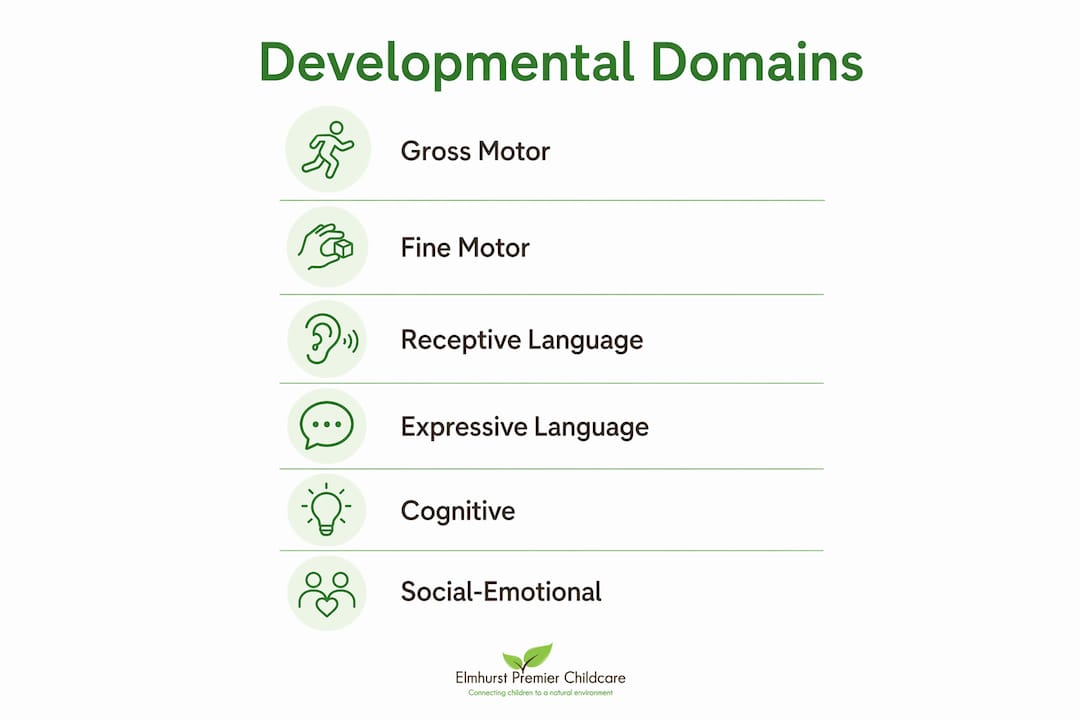
Child development researchers organize growth into six core domains: gross motor skills, fine motor skills, receptive and expressive language, cognitive development, social-emotional development, and self-help or adaptive skills. No domain develops in isolation. A child learning to pour water (fine motor) is also practicing patience (self-regulation) and following instructions (receptive language) at the same time.
Self-regulation deserves special attention. Self-regulation skills predict college degree completion more reliably than early math or reading scores. That finding surprises most parents, who assume academic drills in preschool give children an edge. The research says the opposite. A child who can persist through a hard puzzle, manage frustration, and collaborate with peers carries those skills into every classroom and workplace they will ever enter.
Three principles guide effective ECE programs:
- Play-based learning: Purposeful play builds curiosity, persistence, imagination, and a lifelong love of learning by engaging children with people, places, and objects in meaningful ways.
- Responsive caregiving: Educators who notice and respond to each child’s cues build the secure attachment that makes learning feel safe.
- Intentional curriculum design: Activities are planned with specific developmental goals in mind, not chosen at random to fill time.
Pro Tip: When you visit a program, watch whether educators get down to the child’s level during play. That physical gesture signals responsive caregiving, one of the strongest predictors of quality.
How do you choose a quality early childhood program?
Parents often use the words childcare, daycare, and preschool interchangeably. They are not the same thing. Daycare typically refers to supervised care with no formal learning goals. Preschool and formal ECE programs use structured curriculum, trained educators, and developmental assessments to intentionally support growth. Knowing the difference helps you ask better questions.
Use these criteria when evaluating any program:
- Educator qualifications: Ask specifically about degrees, credentials, and ongoing professional development. State minimums are a floor, not a standard of excellence.
- Curriculum framework: Look for a named, research-backed approach. Elmhurst Premier Childcare uses a hands-on STEAM curriculum that integrates science, technology, engineering, arts, and math through developmentally appropriate experiences.
- Class size and ratios: Smaller groups allow individualized attention. Large group sizes are a red flag regardless of how polished the facility looks.
- Family communication: Quality programs give parents regular, specific updates, not just a daily mood check.
- Physical environment: Spaces should be safe, organized, and stocked with materials that invite exploration, not just passive entertainment.
Program length also matters. Two years of quality ECE produces stronger outcomes than one year, particularly for language development and early number concepts. If your child can start at age 3 rather than waiting until the year before kindergarten, the developmental return is significant.
Pro Tip: Ask any program director: “What does a typical morning look like for a 4-year-old here?” A confident, specific answer reveals intentional planning. A vague answer reveals the opposite.
Globally, only one-third of countries are on track to meet access targets for ECE, and 91 out of 188 countries provide zero years of free compulsory early education. Access and affordability are real barriers. Knowing what quality looks like helps you advocate effectively when options are limited.
What can parents do at home to support early learners?
The home environment is a child’s first classroom. Consistent routines and positive relationships with caregivers are as important as any classroom material for healthy development. Predictable daily rhythms, like regular mealtimes, bedtime rituals, and reading together, give children the security they need to take learning risks.
Everyday interactions are your most powerful teaching tool. Rich conversation, not screen time, builds vocabulary and reasoning. When you narrate what you are doing (“I’m cutting the apple into four pieces. Now we have four equal parts.”), you are building number concepts and language simultaneously. When you ask open-ended questions (“What do you think will happen if we add more water?”), you are practicing scientific thinking.
Here are four research-backed practices to build into daily life:
- Read aloud daily. Point to words, ask predictive questions, and let your child turn pages. This builds print awareness, vocabulary, and listening comprehension.
- Let children problem-solve. Resist the urge to fix every puzzle or conflict immediately. Productive struggle builds persistence, which predicts long-term success more than early academic knowledge.
- Name emotions out loud. “You look frustrated. That block keeps falling.” Labeling feelings builds emotional vocabulary and self-regulation.
- Play without a script. Unstructured play, where your child leads and you follow, builds imagination, creativity, and confidence.
Pro Tip: The role of play in preschool is not a break from learning. It is the primary vehicle for it. Treat play at home the same way.
What are common misconceptions about early childhood education?
The most damaging misconception is that quality ECE means drilling letters and numbers early. Academic pressure in preschool does not produce better kindergarteners. It produces anxious ones. The research is clear: self-regulation and curiosity predict academic success far more reliably than early mastery of the alphabet.
A second misconception is that any licensed facility offering childcare provides ECE. Licensing sets a safety baseline. It does not guarantee intentional curriculum, trained educators, or developmental support. Educator training and access are the largest global challenges to equitable, high-quality early learning. A license tells you a building passed a safety inspection. It tells you nothing about what happens inside the classroom.
Watch for these red flags in any program:
- High educator turnover, which disrupts the consistent relationships children need
- No written curriculum or developmental framework
- Passive activities like extended screen time filling large portions of the day
- Vague or infrequent communication with families
- Educators who cannot explain the developmental purpose of specific activities
“Early childhood education should be understood as a foundational support system for lifelong well-being, not merely a childcare arrangement.” — OECD
Parents who know what quality looks like are better positioned to ask hard questions, spot problems early, and advocate for their child’s needs. That knowledge is not optional. It is part of the job.
Key takeaways
Quality early childhood education builds the cognitive, social, and emotional foundations that predict lifelong success, making the birth-to-age-8 window the highest-return period for intentional learning investment.
| Point | Details |
|---|---|
| Brain development peaks early | Over 80% of brain development occurs by age 5, making early years the most critical window for learning. |
| Self-regulation outranks academics | Persistence, curiosity, and emotional control predict long-term success better than early reading or math scores. |
| Two years beats one | Children attending two years of quality ECE show stronger language, number, and social skills at school entry. |
| Educator quality is non-negotiable | Trained educators with ECE credentials and ongoing development are the single strongest indicator of program quality. |
| Home environment matters equally | Consistent routines, rich conversation, and responsive relationships at home reinforce everything learned in formal programs. |
What I’ve learned from watching children thrive in quality ECE settings
Parents often ask me whether the difference between a quality program and an average one is really that noticeable. After years of working in and around early childhood education, my honest answer is yes, and faster than most people expect.
The children who arrive in kindergarten most prepared are rarely the ones who spent preschool memorizing flashcards. They are the ones who learned to ask questions, try again after failing, and work through a disagreement with a friend. Those skills come from intentional environments where educators know each child well enough to challenge them at exactly the right level.
What I tell every parent is this: your involvement does not stop at drop-off. The families who stay curious about what their child is learning, who ask teachers specific questions, and who extend learning at home are the ones whose children make the most visible progress. ECE is a partnership, not a service you purchase and walk away from.
Every child develops on their own timeline. The goal of quality early learning is not to accelerate that timeline. It is to make sure nothing gets in its way.
— Kasindra
Elmhurst Premier Childcare’s approach to early learning
Elmhurst Premier Childcare was built on the exact principles this article describes: trained educators, intentional curriculum, individualized learning, and genuine family partnership. Every educator holds or is actively earning an ECE degree, CDA, or CCP credential. The preschool program and pre-K program use a hands-on STEAM curriculum designed to build kindergarten readiness through play, creativity, and critical thinking, not rote memorization.
Families receive daily updates, participate in school events, and have access to a Parent Committee that keeps communication open and meaningful. If you want to see what intentional early childhood education looks like in practice, book a tour and meet the educators who will know your child by name, personality, and potential.
FAQ
What is early childhood education exactly?
Early childhood education is intentional learning and care that supports cognitive, social-emotional, language, and physical development from birth through age 8. It goes well beyond basic childcare by using trained educators, structured curriculum, and developmental goals.
At what age should my child start an ECE program?
Research shows that starting quality ECE at age 3 rather than waiting until the year before kindergarten produces stronger developmental outcomes, particularly for language and social skills. Two years of quality programming consistently outperforms one year.
Is play-based learning actually effective?
Yes. Purposeful play builds persistence, curiosity, imagination, and social skills, all of which predict long-term academic success more reliably than early drills in letters or numbers. The OECD and UNICEF both identify play-based learning as a core feature of effective ECE programs.
How do I know if a preschool program is high quality?
Look for credentialed educators, a named curriculum framework, small class sizes, regular family communication, and a physical environment that invites active exploration. Programs that cannot clearly explain the developmental purpose of their daily activities are worth questioning.
How can I support my child’s development at home?
Read aloud daily, use rich conversation during everyday tasks, let your child lead during unstructured play, and name emotions out loud. Consistent routines and responsive relationships at home reinforce the skills children build in formal early learning programs.