Professional development for educators is the ongoing process of building the skills, knowledge, and collaborative habits that directly improve what happens inside a classroom. Research is unambiguous: teacher effectiveness drives outcomes so powerfully that a child assigned to a high-effectiveness teacher versus a low-effectiveness one can gain or lose the equivalent of a full academic year of learning in a single school year. That gap is not a policy abstraction. It shows up in reading scores, math confidence, and a child’s relationship with learning itself. Understanding why professional development for educators matters is the first step toward choosing the right environment for your child.
How does professional development improve teaching effectiveness?
Educator quality is not fixed at graduation. It grows, or it stagnates, depending on whether teachers receive sustained, structured support after they enter the classroom.
The clearest evidence comes from pedagogical knowledge research. Educators with higher general pedagogical knowledge spend more time on actual teaching and less time managing behavior. That shift correlates directly with improved student scores in mathematics and reading on PISA assessments. The implication is straightforward: when teachers know more about how learning works, children spend more time learning.
The benefits of teacher development show up in specific, measurable ways:
- Stronger classroom management. Educators who understand child development respond to behavior with intention rather than reaction, which keeps instruction moving.
- Better lesson design. Trained educators connect new concepts to what children already know, which accelerates retention.
- Higher student achievement. Research links improved pedagogical knowledge directly to gains in reading and math assessments.
- Greater teacher confidence. Educators who receive ongoing support report higher job satisfaction, which reduces turnover and gives children consistent relationships.
Consistency matters more in early childhood than at any other stage. A child who loses a trusted educator mid-year loses more than a teacher. They lose a relationship that made the classroom feel safe.
What are the most effective forms of professional development?
Not all professional development produces the same results. A one-day workshop on a new curriculum rarely changes what a teacher does on Monday morning. The impact of professional learning depends heavily on how it is structured and sustained.
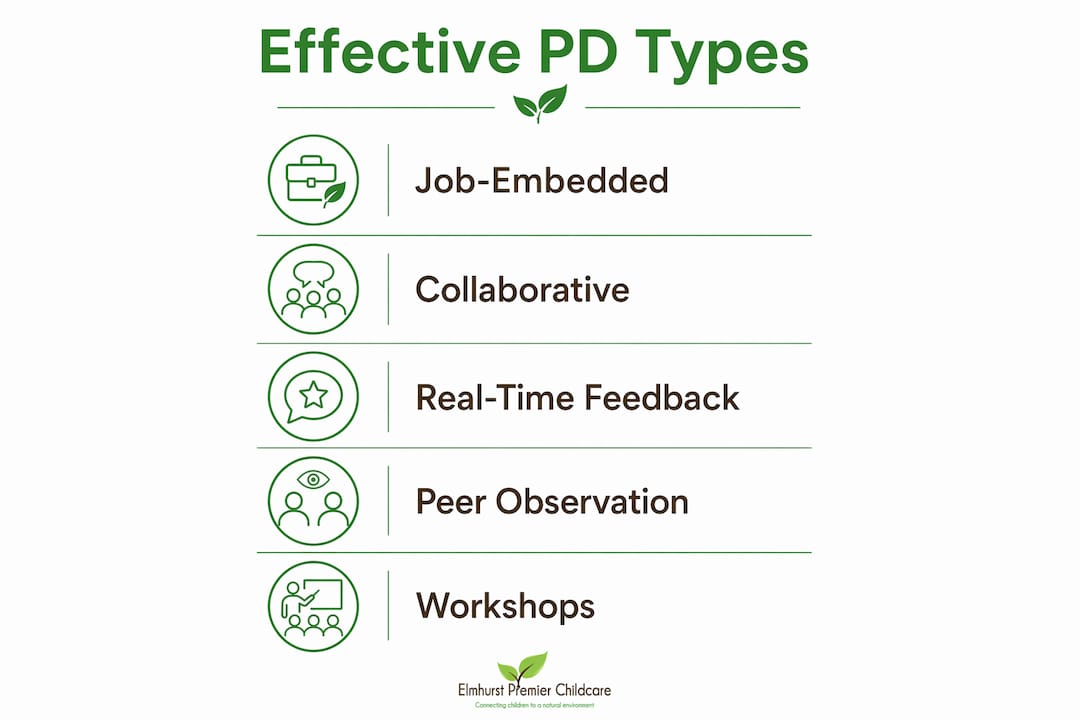
Over 66% of public K-12 teachers identify collaboration with other educators as the most useful component of professional development, rating it above traditional training models for its effect on student achievement. That preference aligns with what research confirms: job-embedded, collaborative learning with immediate application and real-time feedback produces better long-term skill retention than isolated workshops.
The most effective models share four characteristics:
- Job-embedded practice. Teachers apply new strategies in their own classrooms the same week they learn them, not six months later at a follow-up session.
- Professional learning communities (PLCs). Small groups of educators meet regularly to review student work, share what is working, and problem-solve together.
- Continuous feedback. Administrators or mentors observe classrooms and provide specific, timely input rather than annual evaluations.
- Administrative support. Research confirms that admin support, PLCs, and systematic feedback drive teacher capacity building more than any single training event.
Pro Tip: When evaluating a childcare center or school, ask how often teachers receive feedback on their classroom practice. A center that can answer that question specifically invests in its educators. One that cannot may be relying on minimum standards.
Team-teaching models and peer observation rounds are two underused tools in early childhood settings. When one educator teaches while another observes and takes notes, both teachers grow. The observer sees strategies they can adopt. The teacher being observed reflects more carefully on their own choices.
Why does professional development matter in early childhood education?
Early childhood is the period when the brain forms its fastest connections. The quality of a child’s learning environment between birth and age five shapes language development, executive function, and social skills in ways that persist for decades. That reality places an enormous responsibility on early childhood educators, and it makes ongoing educator growth more urgent, not less, than at any other grade level.
The specific challenges of early childhood classrooms make this even clearer. Educators work with children who cannot yet self-regulate, who communicate through behavior before words, and who learn through play rather than direct instruction. Without sustained, context-responsive professional development, educators default to what feels manageable rather than what research shows is most effective. Sustained training produces measurable improvements in classroom practice, particularly in foundational literacy and numeracy, even in resource-limited settings.
“Sustained professional development produces measurable improvements in classroom practice and foundational learning, especially in resource-constrained environments. Teachers who receive ongoing, context-sensitive support develop greater resilience and maintain improved pedagogical approaches beyond the period of external funding.”
The benefits of this kind of training in early childhood settings include:
- Improved child engagement. Educators trained in play-based learning design activities that hold children’s attention and build skills simultaneously.
- More inclusive classrooms. Professional development in inclusive pedagogy helps educators recognize and respond to different learning styles and developmental paces.
- Better language-rich environments. Trained educators use specific strategies, like open-ended questioning and narrating play, that accelerate vocabulary growth.
- Stronger transitions to kindergarten. Children taught by professionally developed educators arrive at kindergarten with stronger social, cognitive, and academic foundations.
Elmhurst Premier Childcare requires every educator to hold an early childhood degree or related credential, or to actively pursue a Child Development Associate (CDA) or Certified Childcare Professional (CCP) certification. That requirement exists because the research on early childhood outcomes is clear: credential level and ongoing training predict classroom quality more reliably than any other single factor.
How can parents recognize educator professional development in action?
Parents cannot sit in on every lesson, but the signs of a professionally developed educator are visible in how a classroom runs and how a child talks about their day.
| What parents observe | What it signals |
|---|---|
| Teacher uses open-ended questions with children | Training in language development and inquiry-based learning |
| Classroom has rotating, themed learning stations | Curriculum planning grounded in developmental research |
| Child references specific activities by name at home | Structured, memorable learning experiences rather than free play only |
| Teacher communicates proactively about child progress | Training in family engagement and child-centered documentation |
| Behavior is redirected calmly and specifically | Competence in positive behavior support strategies |
A professionally developed educator does not just manage a room. They design an environment where every interaction teaches something. Parents who understand certified educator benefits can ask better questions during school tours and make more informed enrollment decisions.
Pro Tip: Ask a prospective educator what they learned most recently in a training or workshop. A confident, specific answer tells you that professional growth is part of their identity, not just a checkbox on their annual review.
The parent-educator relationship also reflects professional development. Educators trained in family engagement share observations, invite questions, and explain the reasoning behind classroom choices. That transparency is not a personality trait. It is a skill built through practice and training.
Key Takeaways
Ongoing professional development is the single most reliable predictor of educator quality, and educator quality is the single most reliable predictor of children’s learning outcomes.
| Point | Details |
|---|---|
| Teacher quality drives outcomes | A high-effectiveness teacher can produce one full year more of learning than a low-effectiveness peer. |
| Collaboration outperforms workshops | Over 66% of teachers rate collaborative PD as most impactful; job-embedded practice yields better retention. |
| Early childhood stakes are highest | Brain development between birth and age five makes educator quality more consequential than at any later stage. |
| Parents can spot trained educators | Look for open-ended questioning, proactive communication, and calm, specific behavior redirection. |
| Credentials signal commitment | Requiring CDA, CCP, or degree-level training sets a measurable floor for classroom quality. |
What I’ve learned watching professional development actually work
I have spent years watching the gap between what educators know and what they actually do in the classroom. That gap is real, and it has a name: the knowing-doing gap. Research confirms that video modeling and observational practice help educators bridge that gap more effectively than lecture-based training. Seeing a strategy demonstrated in a real classroom, then trying it yourself while a colleague watches, changes behavior in a way that reading a manual never does.
The other thing I have observed is that professional development is not one-size-fits-all. Teachers with lower baseline competence gain more from targeted development than experienced educators do, which means a good program meets educators where they are rather than delivering the same content to everyone. A novice teacher learning classroom management needs different support than a ten-year veteran learning a new curriculum framework.
What I find most encouraging is that the research and the practice are finally pointing in the same direction. Collaborative, job-embedded, feedback-rich professional development works. Centers and schools that build it into their culture, rather than treating it as an annual obligation, produce educators who stay, grow, and deliver measurably better experiences for children. That is not an aspiration. It is a documented outcome.
— Kasindra
How Elmhurst Premier Childcare puts educator growth into practice
At Elmhurst Premier Childcare, educator professional development is not an afterthought. Every teacher is required to hold or actively pursue an early childhood degree, CDA, or CCP credential, setting a standard that goes well beyond Illinois state minimums.

That commitment to educator growth shows up directly in the classroom. The STEAM curriculum at Elmhurst Premier Childcare is built on hands-on, play-based learning that requires educators to be skilled observers, thoughtful planners, and responsive teachers. Families exploring early learning options in Elmhurst can learn more about the preschool program and see firsthand how trained educators shape every part of a child’s day. When educator quality is the standard, not the exception, children experience the difference every morning they walk through the door.
FAQ
Why does professional development matter for early childhood educators?
Professional development builds the pedagogical skills that directly improve child outcomes. Research shows that teacher effectiveness can produce a difference of one full academic year of learning within a single school year.
What type of professional development is most effective for teachers?
Job-embedded, collaborative professional development with real-time feedback produces the strongest long-term skill retention. Over 66% of teachers rate peer collaboration as the most impactful form of professional growth.
How does educator training affect children’s learning outcomes?
Educators with stronger pedagogical knowledge spend more time teaching and less time managing behavior, which correlates with higher student scores in reading and math assessments.
What credentials should parents look for in early childhood educators?
Parents should look for educators who hold or are pursuing a Child Development Associate (CDA), Certified Childcare Professional (CCP), or an early childhood education degree, as these credentials signal a measurable commitment to classroom quality.
How can parents tell if a childcare center invests in educator development?
Ask how often teachers receive classroom feedback and what recent training they have completed. Centers that answer specifically and confidently treat professional development as a core practice, not a compliance requirement.