Organic baby food daycare is the practice of selecting, preparing, and delivering certified-organic meals that meet daycare feeding policies while supporting healthy infant and toddler development. The American Academy of Pediatrics and the CDC recommend starting varied, nutrient-dense complementary foods at around 6 months, avoiding added sugars and excessive sodium from the start. Getting that nutrition right at home is one challenge. Getting it right inside a daycare setting, with its labeling rules, refrigeration limits, and allergy protocols, is another challenge entirely. This guide covers every step, from policy compliance to food prep to caregiver communication.
What are daycare feeding policies for organic baby food?
Daycare feeding policies are the rules that govern what food enters the facility, how it is stored, and how it is served. Understanding these rules before you pack a single pouch saves you from wasted food, rejected containers, and frustrated caregivers.
Most licensed daycare centers follow a standard set of requirements:
- Child’s name, date, and contents must appear on every container. Use a waterproof marker or printed label so the information survives refrigerator condensation.
- Glass containers are prohibited. Non-breakable containers are required across virtually all licensed facilities. Silicone squeeze tubes and BPA-free plastics are the accepted standard.
- Honey is prohibited for children under 12 months due to botulism risk. Fruit juice is limited to no more than 4 ounces daily for toddlers ages 1–3. These are not suggestions; they are safety standards enforced at the facility level.
- Allergy protocols require written documentation. If your child has a known allergy, submit it in writing before the first day and update it whenever anything changes.
- Refrigeration varies by facility. Some daycares accept refrigerated pouches; others only accommodate shelf-stable products. Confirm storage capacity before you buy in bulk.
Pro Tip: Ask your daycare for its written feeding policy during the tour, not after enrollment. The answers will shape every purchasing and prep decision you make.
Policies also vary by state licensing requirements. A center in Illinois, for example, operates under Illinois Department of Children and Family Services rules, which set minimum standards that quality centers like Elmhurst Premier Childcare choose to exceed. Always read the specific policy document your center provides, not a generic checklist from the internet.

Which organic baby food options work best for daycare?
The best organic baby food for daycare balances nutrition, packaging safety, and practical storage. Not every product that is great at home works inside a daycare environment.
Shelf-stable pouches vs. refrigerated options
Parents choosing organic baby food face a core decision between refrigerated cold-pressed products and shelf-stable pressure-cooked pouches. Cold-pressed options preserve more heat-sensitive vitamins but require consistent refrigeration. Shelf-stable pouches survive without refrigeration, making them far easier for daycares to manage. Verify your daycare’s storage policy before committing to either format.
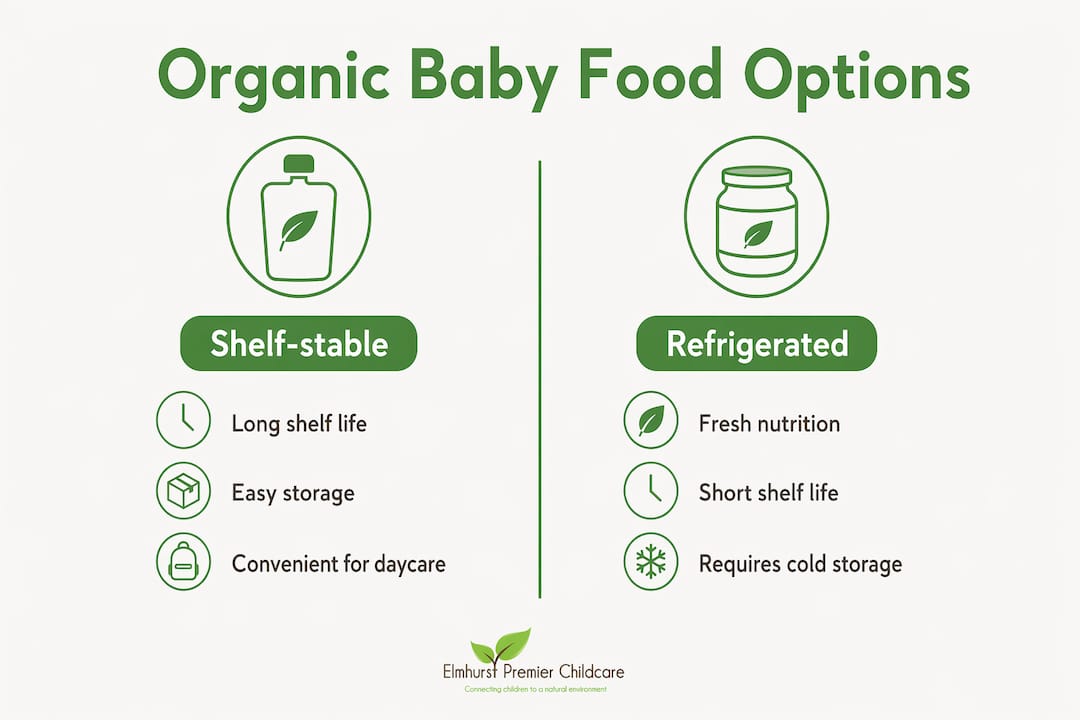
| Format | Nutrition profile | Daycare convenience | Storage requirement |
|---|---|---|---|
| Cold-pressed refrigerated | Higher vitamin retention | Lower (needs cold chain) | Refrigerator required |
| Shelf-stable pouch | Good, heat-processed | High (no cold chain) | Room temperature |
| Homemade frozen puree | Excellent, customizable | Moderate (needs thawing plan) | Freezer then refrigerator |
| Shelf-stable jarred food | Adequate | High | Room temperature |
What to look for in organic baby food nutrition
Nutrient density matters more than calorie counting when feeding infants and toddlers. That principle changes how you read a label. A pouch with 15 grams of sugar from fruit concentrate is not the same as one built around vegetables, legumes, and healthy fats.
Look for these qualities when selecting the best organic baby meals:
- Iron-rich ingredients such as lentils, dark meat poultry, or fortified grains. Pair them with vitamin C sources like bell peppers or berries to improve absorption, which directly supports brain development.
- Low added sugar. Fruit is fine; fruit juice concentrate as a primary ingredient is not.
- Short ingredient lists. Fewer ingredients typically mean less processing and better nutrient retention.
- USDA Organic certification. The label confirms the product meets federal organic standards, not just a brand’s marketing claim.
Early-life nutrition programs long-term gut health, affecting immunity and metabolism well into childhood. Choosing minimally processed, nutrient-dense foods in the early months is not a preference. It is an investment in your child’s long-term health.
How to prepare and store homemade organic baby food for daycare
Homemade organic baby food gives you full control over ingredients, sourcing, and texture. It also requires more planning than buying pouches off a shelf.
Step-by-step preparation
- Choose your produce. Fresh organic produce works well, but frozen fruits and vegetables are equally nutritious. Frozen produce is picked at peak ripeness and flash-frozen, preserving vitamins effectively. It is also more affordable and available year-round.
- Steam, do not boil. Steaming retains more water-soluble vitamins than boiling. Use a steamer basket over an inch of water and cook until soft enough to puree smoothly.
- Puree to the right texture. Use a blender, food processor, or immersion blender. Add breast milk, formula, or cooled boiled water to reach the right consistency for your child’s stage.
- Cool quickly. Spread puree in a thin layer on a clean baking sheet or pour into ice cube trays. Refrigerate or freeze within two hours of cooking.
- Label everything. Write the food type, preparation date, and your child’s name on every container before it leaves your kitchen.
Safe storage durations
| Storage method | Maximum safe duration | Best container |
|---|---|---|
| Refrigerator (40°F or below) | 48 hours | BPA-free sealed container |
| Freezer (0°F or below) | 3 months | Silicone ice cube tray, then zip bag |
| Reusable silicone pouch | 48 hours refrigerated | Silicone squeeze tube |
Pro Tip: Freeze purees in ice cube trays first, then transfer the frozen cubes to labeled zip bags. Each cube is roughly one ounce, making portion control simple and waste minimal.
Silicone squeeze tubes and BPA-free plastics are the preferred containers for daycare use. They are durable, easy to clean, and accepted at virtually every licensed facility. Never send glass. Never send unlabeled containers. Both will be turned away.
A common preparation mistake is making large batches without checking what the daycare can actually store. Confirm refrigerator and freezer space before you prep a week’s worth of food. Some centers have very limited storage and can only accommodate one or two days at a time.
How do you communicate with daycare providers about organic baby food?
Clear, written communication with your daycare provider is the single most effective way to protect your child’s nutrition and safety. Verbal conversations get forgotten. Written instructions do not.
Build a communication system that covers these areas:
- Written feeding schedule. Include feeding times, portion sizes, food types, and any texture preferences. Update it as your child’s needs change, which happens quickly in the first year.
- Allergy and sensitivity documentation. Submit this in writing on day one. Include the specific allergen, the reaction to watch for, and the action to take. Do not assume verbal communication is enough.
- Storage and serving instructions. Note whether food needs to be warmed, served cold, or mixed with anything. Caregivers serve many children; clear instructions prevent errors.
- A 24-hour backup supply. Provide a backup supply of food that stays at the daycare in case you forget to pack food or a container leaks. Shelf-stable pouches work well for this purpose.
- Ongoing updates. Schedule a brief check-in every few weeks, especially during the 6–12 month window when textures and foods change rapidly. A quick written note in the daily communication log works well.
The goal is to make feeding your child as easy as possible for the caregiver. When instructions are clear and food is properly labeled, caregivers can focus on your child rather than guessing. Parents who tour a center should ask specific questions about feeding procedures. The daycare tour questions guide from Elmhurst Premier Childcare covers exactly what to ask about infant feeding policies before you enroll.
Key takeaways
Organic baby food success at daycare depends on knowing the rules, choosing the right products, preparing food safely, and communicating clearly with caregivers.
| Point | Details |
|---|---|
| Know the feeding policy first | Confirm refrigeration, labeling, and prohibited food rules before purchasing any organic products. |
| Prioritize nutrient density | Choose foods rich in iron and vitamin C over high-sugar fruit pouches for better developmental outcomes. |
| Label every container | Write child’s name, food type, and date on every item using a waterproof marker. |
| Freeze in single portions | Use silicone ice cube trays to freeze homemade purees in one-ounce portions for easy daycare packing. |
| Write everything down | Submit feeding schedules, allergy information, and serving instructions in writing, not verbally. |
What I’ve learned from watching parents navigate organic feeding at daycare
The parents who struggle most with organic baby food at daycare are not the ones who chose the wrong products. They are the ones who assumed the daycare would figure it out.
I have seen parents spend real money on cold-pressed refrigerated pouches, only to discover their daycare has no refrigerator space for outside food. I have seen beautifully prepared homemade purees turned away because the container was not labeled. These are not failures of effort. They are failures of information, and they are completely avoidable.
The most successful parents treat the daycare feeding conversation like a partnership, not a transaction. They ask questions during the tour, submit written instructions before day one, and check in regularly as their child’s diet evolves. They also accept that convenience and nutrition are not opposites. A shelf-stable USDA Organic pouch with a clean ingredient list is a genuinely good choice. Homemade is not always better if the logistics fall apart.
One thing I want parents to hear: do not let perfect be the enemy of good. If your child gets organic, nutrient-dense food five days a week at daycare, that is a win. The goal is consistency over time, not perfection at every meal. Build systems that are sustainable for you and workable for the caregivers, and the nutrition will follow.
— Kasindra
Nutrition at Elmhurst Premier Childcare
Elmhurst Premier Childcare takes fresh, nutritious meals seriously as part of its commitment to whole-child care. The center’s Fresh Meals and ChildEats program features organic food and milk options designed to support healthy development from infancy through the preschool years.
As a locally owned boutique school, Elmhurst Premier Childcare works directly with families to accommodate individual feeding needs, dietary preferences, and organic nutrition goals. Decisions are made here in Elmhurst, not in a corporate office, which means your child’s specific needs actually get heard. Parents interested in the infant and toddler programs are encouraged to book a tour and ask about feeding policies, meal programs, and how the team supports organic nutrition every day.
FAQ
What is organic baby food daycare?
Organic baby food daycare refers to the practice of providing certified-organic meals and snacks to infants and toddlers within a licensed childcare setting. It involves selecting appropriate products, following daycare feeding policies, and communicating dietary needs clearly to caregivers.
When should babies start solid foods at daycare?
The CDC recommends starting complementary solid foods at around 6 months while continuing breast milk or formula. Parents should coordinate the timing with both their pediatrician and their daycare provider before introducing new foods.
Can I send homemade baby food to daycare?
Most licensed daycares accept homemade baby food when it is stored in non-breakable, BPA-free containers and labeled with the child’s name, food type, and preparation date. Always confirm your specific center’s policy before sending homemade food.
Are glass containers allowed at daycare?
Glass containers are prohibited at virtually all licensed daycare centers. Silicone squeeze tubes and BPA-free plastic containers are the accepted standard for both safety and storage durability.
How much fruit juice can toddlers have at daycare?
The CDC limits fruit juice to no more than 4 ounces daily for toddlers ages 1–3. Many daycares enforce this limit as part of their standard feeding policy, and parents should not send juice beyond that amount.