A preschool curriculum is a structured, developmentally appropriate framework that guides young children’s learning across cognitive, social, emotional, and physical domains. The right curriculum does more than fill a child’s day with activities. It builds a coherent foundation for kindergarten readiness and lifelong learning. This choosing preschool curriculum guide walks you through what quality looks like, how to evaluate your options, and how to match a program to your child’s unique needs. The NASEM 2024 report identified 29 specific elements of curriculum quality, which tells you just how much depth this decision deserves.
What are the core features of a high-quality preschool curriculum?
A high-quality preschool curriculum includes a scope and sequence that aligns with developmental trajectories to build learning coherently across all domains. That means skills build on each other in a logical order, rather than appearing as disconnected activities. Without this structure, children miss foundational concepts that later learning depends on.
Strong curricula cover multiple learning domains at once. Look for programs that address all of the following:
- Social-emotional development: Learning to share, manage emotions, and build friendships
- Cognitive skills: Problem-solving, memory, and early reasoning
- Literacy and language: Phonological awareness, vocabulary, and storytelling
- Math concepts: Counting, patterns, shapes, and spatial reasoning
- Physical development: Fine and gross motor skills through movement and hands-on tasks
- Creative arts: Music, drawing, and dramatic play that build self-expression
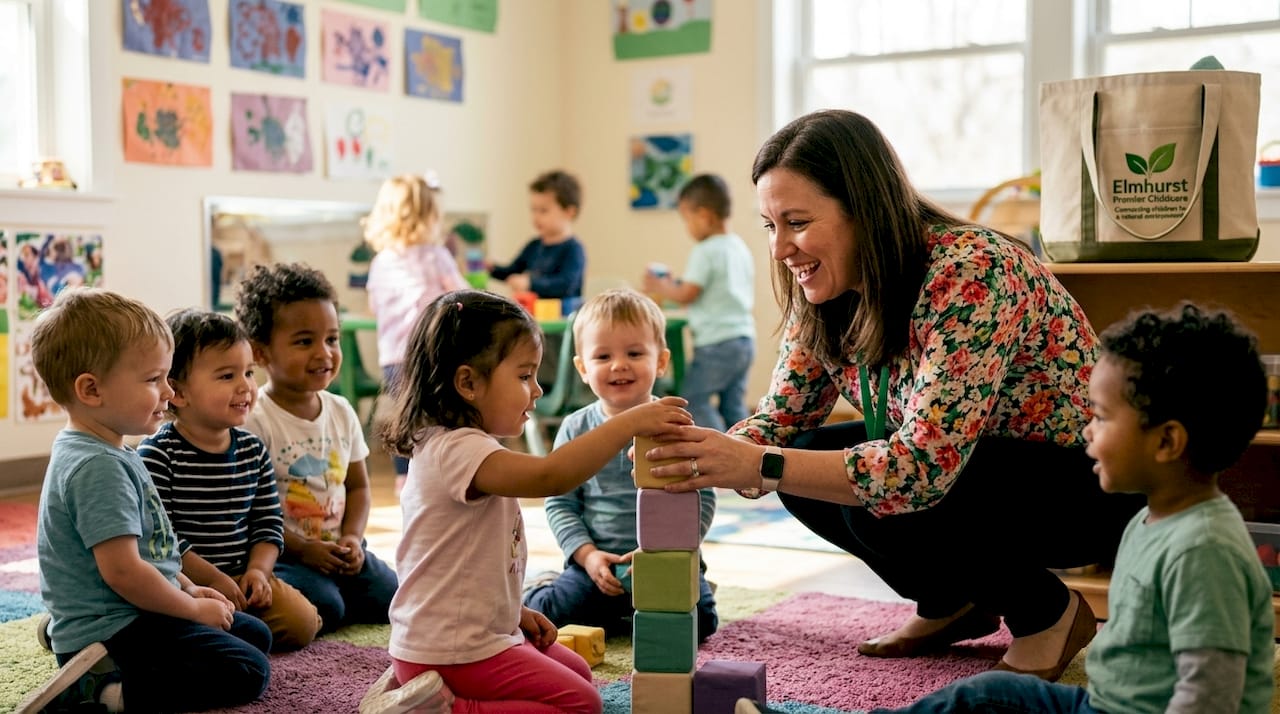
Curricula should also support multilingual learners and children with disabilities by adapting materials and training teachers accordingly. This is not optional. Equity in access means every child can participate fully, not just children who fit a narrow developmental profile.
Teacher support is the other non-negotiable. Professional development investment ranges from $165 to $5,000 per teacher annually, and that range reflects how seriously a program takes implementation quality. A curriculum without trained, supported teachers is just a binder on a shelf.
Pro Tip: Ask any preschool you visit how often teachers receive curriculum training and what that training looks like. The answer tells you more about program quality than any brochure.
How do you evaluate and compare preschool curriculum options?
Evaluating preschool programs requires more than reading a school’s website. The most reliable method is direct observation. Visit classrooms during active learning time and watch how teachers interact with children, not just what materials are on the walls.
Use this checklist when you visit or speak with program directors:
- Does the curriculum cover all developmental domains? Look for evidence of literacy, math, social-emotional, and physical activities in the daily schedule.
- How do teachers facilitate learning? Strong teachers ask open-ended questions, follow children’s curiosity, and build on what children already know.
- Is assessment ongoing and observational? Effective preschool assessment uses observational data integrated with curriculum to refine teaching, not rigid standardized tests.
- Does the program align with your family’s values? A curriculum that conflicts with how your family approaches learning will create friction, not growth.
- What are the teacher qualifications? At Elmhurst Premier Childcare, every educator holds an early childhood degree or a Child Development Associate (CDA) or Certified Childcare Professional (CCP) credential. That standard matters.
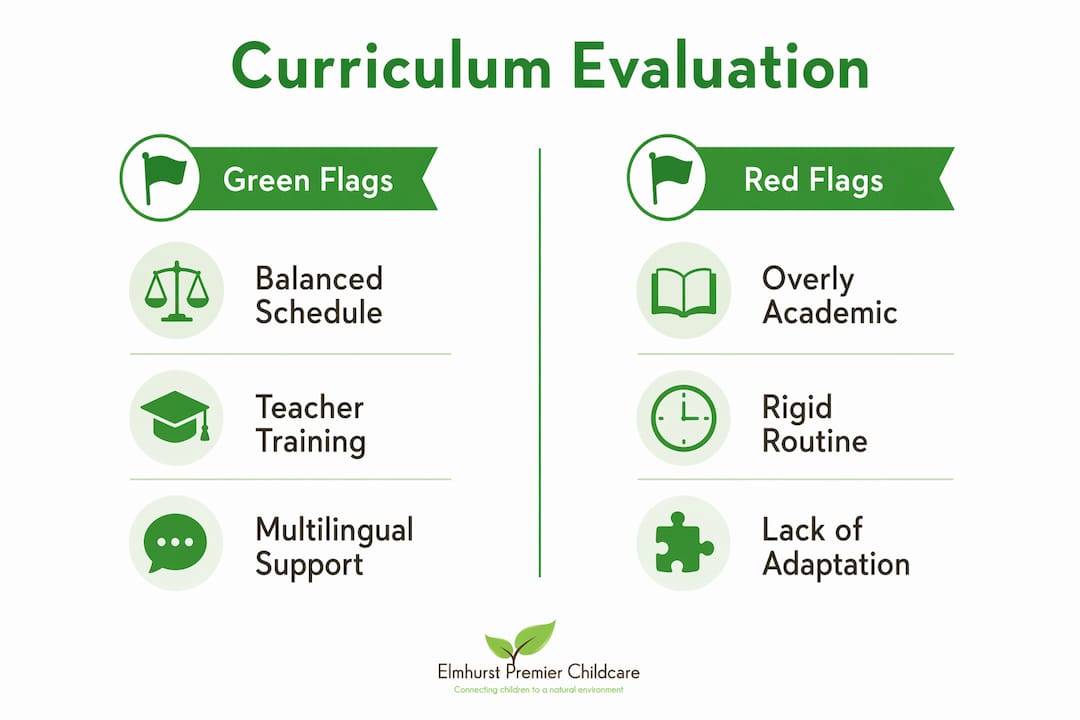
Here is a quick comparison of what to look for versus what to watch out for:
| Evaluation area | Green flag | Red flag |
|---|---|---|
| Daily schedule | Mix of play, small groups, and direct instruction | Long periods of whole-group instruction only |
| Teacher interaction | Warm, responsive, asks open questions | Mostly directive or passive supervision |
| Assessment method | Ongoing observation and documentation | Standardized tests as the only measure |
| Curriculum coverage | Multiple developmental domains addressed | Focus on academics only |
| Inclusion practices | Adapts for diverse learners | One-size-fits-all approach |
Pro Tip: Bring a short list of three to five specific questions to every school visit. Ask what a typical Tuesday morning looks like, not just what the curriculum is called.
The teacher’s ability to facilitate play and build relationships is a stronger predictor of child success than curriculum brand. That finding should shift where you focus your attention when comparing programs.
What types of preschool curriculum approaches exist?
Parents encounter a wide range of curriculum philosophies when researching programs. Understanding the major categories helps you ask better questions and avoid being swayed by labels alone.
- Play-based learning: Centers child-directed exploration with teacher guidance. Purposeful play builds early literacy and math skills effectively when it is planned and intentional, not just free time.
- Montessori: Uses self-directed activity, mixed-age groupings, and specialized materials. Quality varies widely by school, so observation matters more than the label.
- Reggio Emilia: Project-based, child-led inquiry with strong emphasis on documentation and the environment as a “third teacher.” Requires highly trained educators to implement well.
- Waldorf: Emphasizes imagination, rhythm, and arts-based learning. Delays formal academics intentionally, which fits some children and families better than others.
- Academic-focused: Prioritizes early reading and math instruction through direct teaching. Intensive early academic instruction can reduce a child’s love of learning when it replaces play entirely.
- Hybrid or STEAM models: Blend structured academic content with hands-on, inquiry-based experiences. Elmhurst Premier Childcare’s STEAM curriculum falls into this category, combining creativity, critical thinking, and kindergarten readiness through developmentally appropriate activities.
Curriculum labels like Montessori or Reggio Emilia vary widely in implementation. Two schools using the same label can look completely different in practice. Visiting classrooms to observe teacher-child interactions gives you far better insight than any program name.
Match the approach to your child’s temperament. A child who thrives with routine and clear structure may struggle in a purely child-directed environment. A highly curious, independent child may feel constrained by heavy direct instruction. Neither is wrong. The fit is what matters.
Common mistakes to avoid when selecting a preschool program
Parents make a handful of predictable errors when comparing preschool options. Knowing them in advance saves time and protects your child from a poor fit.
- Treating play and academics as opposites. The choice is not play versus content. Effective preschool classrooms for ages 3–4 blend purposeful short activities and play rather than lengthy direct instruction. Look for programs that integrate both.
- Trusting curriculum brand names over implementation. A well-known curriculum name means nothing if teachers lack training or support. Curriculum effectiveness depends on implementation quality and ongoing teacher development, not the brand alone.
- Ignoring your child’s individual needs. A curriculum that works beautifully for one child may frustrate another. Consider your child’s temperament, learning pace, and any specific developmental needs before committing.
- Skipping the classroom visit. Reading a school’s website or curriculum summary is not enough. What you see in a real classroom during active learning time tells you everything a brochure cannot.
- Overlooking family values alignment. A program that conflicts with how your family communicates, disciplines, or approaches learning will create tension, not partnership.
The best preschool curriculum respects how children learn, is implemented well by caring teachers, and fits your child’s unique needs and family values. No single branded program guarantees outcomes. The people delivering it do.
Key Takeaways
The most effective approach to preschool curriculum selection combines research-backed quality criteria, direct classroom observation, and honest consideration of your child’s individual needs and your family’s values.
| Point | Details |
|---|---|
| Scope and sequence matter | Choose curricula that build skills coherently across all developmental domains. |
| Teacher quality outweighs brand | Observe teacher-child interactions directly; they predict outcomes better than curriculum labels. |
| Play and academics belong together | Purposeful play-based learning builds literacy and math without sacrificing a child’s love of learning. |
| Inclusion is a quality marker | High-quality programs adapt for multilingual learners and children with disabilities. |
| Observation beats research alone | Visit classrooms during active learning time before making any final decision. |
What I’ve learned after years of watching families choose preschools
Parents come to this decision with the best intentions and, often, a lot of anxiety. The curriculum name becomes a proxy for quality because it feels concrete and searchable. I understand that instinct. But after years of working in and around early childhood education, I can tell you that the name on the curriculum binder is almost never what determines how a child thrives.
What I have seen matter most is whether the teachers genuinely know the children in their care. Not just their names, but their quirks, their fears, what makes them laugh, and what shuts them down. A child who feels known by their teacher will engage with almost any well-designed curriculum. A child who feels invisible will struggle even in the most beautifully resourced classroom.
The other thing parents underestimate is their own instinct. When you walk into a classroom and something feels off, that feeling is data. When you see a teacher get down on the floor with a child who is frustrated and talk them through it quietly, that is also data. Trust what you observe as much as what you read.
My honest advice: use the research to build your checklist, then use your eyes and your gut to make the final call. The right program is the one where your child will be known, challenged, and genuinely cared for. That combination is rarer than it should be, and worth searching for.
— Kasindra
Elmhurst Premier Childcare’s approach to early learning
Choosing a preschool program is one of the most meaningful decisions you will make for your child’s early years. Elmhurst Premier Childcare was built specifically for families who want more than a standard childcare experience.
Every educator at Elmhurst Premier Childcare holds an early childhood degree or a CDA or CCP credential, going well beyond Illinois state minimums. The school’s STEAM curriculum integrates hands-on, play-based learning with creativity, critical thinking, and kindergarten readiness. Small-group interactions and individualized learning are built into every day. Families stay connected through daily updates, family events, and a Parent Committee. If you are ready to see what a thoughtfully designed preschool program looks like in practice, Elmhurst Premier Childcare invites you to book a tour and experience it firsthand.
FAQ
What is a preschool curriculum?
A preschool curriculum is a structured, developmentally appropriate framework that guides learning across cognitive, social-emotional, physical, and language domains for children ages 3–5. It includes planned activities, teaching strategies, and assessment methods aligned with how young children develop.
How do I know if a preschool curriculum is high quality?
A high-quality curriculum covers multiple developmental domains, includes a clear scope and sequence, supports diverse learners, and is backed by ongoing teacher training. The NASEM 2024 report identified 29 specific elements that define curriculum quality at the pre-K level.
Is play-based learning as effective as academic instruction?
Purposeful, planned play-based learning is highly effective for building early literacy and math skills. Research shows that intensive early academic instruction can actually reduce a child’s love of learning when it replaces play entirely rather than integrating with it.
What questions should I ask when visiting a preschool?
Ask what a typical morning looks like, how teachers handle conflict between children, and how the program assesses each child’s progress. Observing teacher-child interactions directly gives you more useful information than any printed curriculum summary.
Does the curriculum brand name matter?
The brand name matters far less than how the curriculum is implemented. Teacher-child relationships and implementation quality are stronger predictors of child success than any specific curriculum label or philosophy.