Preschool learning approaches are defined by the balance they strike between child-led exploration and teacher-directed instruction. The most widely recognized methods of preschool education fall into two broad categories: child-directed models like Montessori and Reggio Emilia, and structured academic programs focused on kindergarten readiness. Understanding these types of early learning helps you match your child’s temperament to the right environment, not just the right label. Elmhurst Premier Childcare draws from multiple preschool educational approaches, blending play, inquiry, and academic skill-building into one cohesive program.
1. Types of preschool learning approaches: the core framework
Preschool learning approaches broadly divide into child-directed and teacher-directed models, each with distinct priorities and classroom structures. Child-directed models prioritize intrinsic motivation, mixed-age classrooms, and open-ended exploration. Teacher-directed models emphasize structured schedules, measurable skill targets, and direct instruction. Most quality programs today sit somewhere between these two poles, borrowing from both traditions. Knowing where a program falls on this spectrum is the first step in evaluating whether it fits your child.
2. The Montessori approach: child-led learning with prepared materials
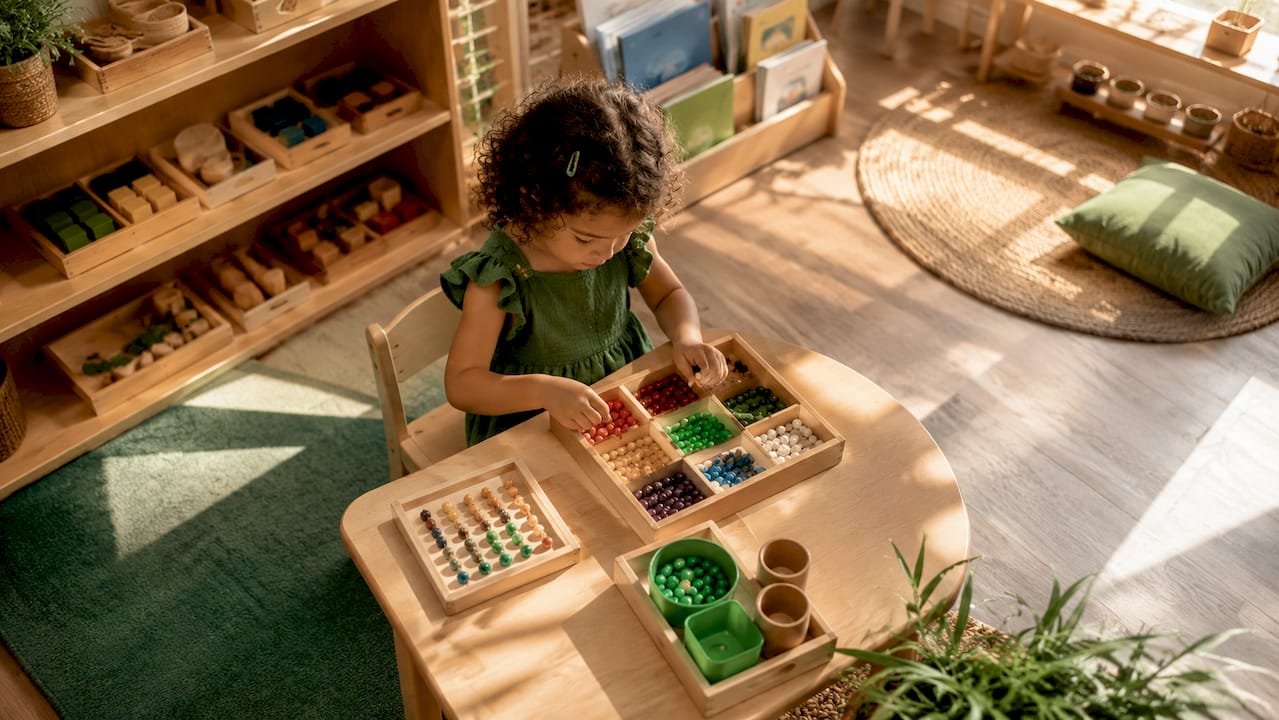
The Montessori method, developed by Dr. Maria Montessori in the early 1900s, places the child as an independent learner within a carefully prepared environment. Teachers act as guides rather than lecturers. Children choose their own work from a curated set of hands-on materials designed to teach specific concepts, from counting beads to sandpaper letters.
Key features of Montessori classrooms include:
- Mixed-age groupings (typically ages 3–6 in one room) so younger children learn by observing older peers
- Uninterrupted work periods of 2–3 hours to support deep focus
- Specific Montessori materials that isolate one concept at a time, making abstract ideas concrete
- Child-chosen activities within a structured range of options
Montessori suits children who are self-motivated, detail-oriented, and comfortable with independent work. It can feel less structured for children who need more direct guidance or thrive with group instruction.
Pro Tip: When visiting a Montessori classroom, watch whether children are genuinely choosing their own work or being redirected constantly. High redirection signals poor implementation, not a Montessori problem.
3. The Reggio Emilia approach: project-based collaborative exploration
The Reggio Emilia approach originated in northern Italy after World War II and treats the child as a capable, curious researcher. There is no fixed curriculum. Instead, teachers observe children’s interests and build extended projects around them, a process called emergent curriculum.
Core elements of Reggio Emilia programs include:
- Documentation panels displaying children’s work, questions, and thinking processes
- The atelier (an art studio space) where children express ideas through drawing, sculpture, and mixed media
- Teachers as co-learners who ask questions alongside children rather than delivering answers
- The environment as the third teacher, meaning classroom design is intentional and provocative
Inquiry-based and project-based programs effectively integrate academic standards through children’s natural interests, promoting sustainable learning. Reggio Emilia is particularly strong for children who are social, creative, and driven by questions. It also builds communication and problem-solving skills through collaborative peer learning that few other models match.
4. Play-based learning: guided play as a foundation for development
Play-based learning is the most widely used preschool educational approach in the United States, but the term covers a wide range of practices. Free play and guided play are not the same thing. Guided play is distinct from free play, involving teachers who deliberately introduce questions and challenges to deepen learning during playtime.
Effective preschool curricula emphasize guided play that embeds intentional instruction to improve literacy, math, and socio-emotional outcomes. That means a teacher building a block tower with a child is also asking, “Which block is heavier?” and “What happens if we put the big one on top?” The play looks casual. The learning is deliberate.
Activities that work well in play-based settings include:
- Dramatic play centers (grocery stores, doctor’s offices) that build vocabulary and social skills
- Sensory bins with sand, water, or rice that develop fine motor skills and scientific thinking
- Building and construction play that introduces early math and spatial reasoning
- Outdoor exploration that supports physical development and observation skills
Pro Tip: Ask any play-based program how teachers document learning during play. Strong programs track individual progress even in unstructured moments. If the answer is vague, the play may not be as purposeful as advertised.
Play-based approaches develop communication and problem-solving skills as foundational competencies. These skills transfer directly into kindergarten readiness, even without formal worksheets.
5. Academic and teacher-directed approaches: structured readiness for kindergarten
Academic preschools offer teacher-led, structured lessons with a focus on letter recognition, phonics, number sense, and early writing. The classroom looks more like a kindergarten than a traditional preschool, with circle time, direct instruction, and measurable skill benchmarks.
Key characteristics of academic preschool programs:
- Scheduled lesson blocks covering literacy, math, and science in sequence
- Worksheets and workbooks used alongside hands-on activities
- Clear skill progression from letter sounds to blending to simple reading
- Regular assessment to track individual progress toward kindergarten benchmarks
This approach suits children who thrive with routine, enjoy structured tasks, and feel confident in adult-led settings. It can feel rigid for highly active or imaginative children who need more movement and open-ended time. The strongest academic programs balance direct instruction with hands-on elements, avoiding a purely paper-and-pencil model. Elmhurst Premier Childcare’s STEAM curriculum reflects this balance, pairing academic skill-building with hands-on investigation.
6. HighScope, Bank Street, and hybrid models
Beyond the four major frameworks, several other preschool methodologies have strong research backing and growing adoption across the country.
HighScope uses a Plan-Do-Review cycle. Children plan what they will do, carry out their plan, and then review what they learned with a teacher. This structure builds metacognition (thinking about thinking) at an age when most programs do not address it at all. HighScope classrooms use “key developmental indicators” to track progress across social, cognitive, and physical domains.
Bank Street takes a developmental-interaction approach rooted in the work of John Dewey and Lucy Sprague Mitchell. It emphasizes learning through direct experience with real-world materials and situations. Teachers build curriculum around children’s social and emotional development as much as academic skills.
Hybrid programs are the fastest-growing category in early childhood education. These programs borrow the child-led exploration of Montessori or Reggio Emilia and combine it with the skill progression of academic models. Elmhurst Premier Childcare operates as a hybrid program, integrating play-based learning with structured STEAM experiences and kindergarten readiness goals.
| Approach | Core method | Best fit |
|---|---|---|
| HighScope | Plan-Do-Review cycle | Children who benefit from structured reflection |
| Bank Street | Real-world, experience-based learning | Social-emotional development focus |
| Hybrid models | Blended play and academic instruction | Families wanting breadth and balance |
7. What the research says about learning styles in preschool
A 2026 study found that preschool children’s dominant learning preferences are 65% visual, 25% auditory, and 10% kinesthetic, yet recommends multisensory teaching to engage all learners. Kinesthetic activities are underused despite producing high engagement. That gap matters because a child labeled “visual” at age four is still developing all three modes of processing.
Limiting instruction to a single perceived learning style restricts development rather than supporting it. Programs benefit most from combining movement, sound, and visuals rather than committing to one channel. This is why multisensory teaching is a best practice across every preschool approach, not just one of them. Whether a program is Montessori, play-based, or academic, the quality of sensory engagement predicts outcomes more reliably than the label on the door.
8. How to evaluate any preschool approach for your child
Parents should evaluate preschool curricula based on child temperament and program implementation quality, not brand or label alone. A well-run play-based program will outperform a poorly run Montessori program every time. The philosophy matters less than how faithfully and skillfully the teachers carry it out.
When visiting any program, watch for these signals:
- Teacher responsiveness: Do teachers get down to children’s level and follow their lead?
- Child engagement: Are most children absorbed in an activity, or wandering without purpose?
- Classroom organization: Does the environment invite exploration, or does it feel chaotic?
- Documentation: Can teachers explain what each child is working on and why?
- Transition quality: Are transitions between activities calm and predictable?
Implementation varies widely even within branded programs. A school calling itself Reggio Emilia-inspired may have one documentation panel and no atelier. A school with no philosophy label may deliver exceptional child-centered learning every day. Visit, observe, and trust what you see over what you read in a brochure.
Key takeaways
The most effective preschool approach is the one implemented with skill, consistency, and genuine attention to each child’s temperament and developmental needs.
| Point | Details |
|---|---|
| Child-directed vs. teacher-directed | Every preschool approach falls on a spectrum; most quality programs blend both styles. |
| Implementation beats labels | A well-run program of any philosophy outperforms a poorly run branded one. |
| Multisensory teaching matters | Programs combining movement, sound, and visuals produce stronger outcomes across all approaches. |
| Guided play is intentional | Effective play-based learning involves deliberate teacher questions, not just free time. |
| Visit before you decide | Classroom observation reveals more about program quality than any philosophy description. |
What I’ve learned about choosing a preschool approach
Parents spend a lot of time researching Montessori versus Reggio Emilia versus play-based, and I understand why. The labels feel like a shortcut to the right answer. But after years of working in and around early childhood education, I’ve come to believe the label is the least reliable signal you have.
The most telling moment in any classroom visit is the five minutes after a child makes a mistake. Does the teacher redirect with curiosity, or with correction? That single interaction tells you more about the program’s actual philosophy than any brochure ever will.
I’ve also seen parents dismiss programs because they don’t carry a recognized name, only to find that those programs deliver the warmest, most responsive teaching they’ve ever witnessed. Conversely, I’ve walked through beautifully branded Montessori rooms where children looked bored and teachers looked disengaged. The philosophy was intact. The execution was not.
My honest advice: bring your child to the visit. Watch how the teachers greet them. Watch whether the room pulls your child in or leaves them flat. A four-year-old’s instincts about a space are remarkably accurate. Choosing a boutique childcare environment often means choosing a place where your child is known by name, not managed by policy. That matters more than any curriculum title.
— Kasindra
How Elmhurst Premier Childcare supports every type of learner
Elmhurst Premier Childcare blends the best of multiple preschool educational approaches into one cohesive program built for real children, not a single learning profile.
The preschool program at Elmhurst Premier Childcare pairs hands-on STEAM experiences with guided play, inquiry-based projects, and structured kindergarten readiness skills. Every educator holds an early childhood degree or credential, going well beyond state minimums. Small group sizes mean teachers actually know each child’s strengths, not just their name. If you want to see the difference between a program built on relationships and one built on enrollment numbers, schedule a tour and see it for yourself.
FAQ
What are the main types of preschool learning approaches?
The main types are Montessori, Reggio Emilia, play-based, academic or teacher-directed, HighScope, Bank Street, and hybrid models. Each differs in how much control children have over their learning and how structured the daily schedule is.
Is play-based learning as effective as academic preschool?
Guided play-based learning produces strong literacy, math, and social outcomes when teachers embed intentional instruction within play activities. The key word is “guided,” not simply free play without adult involvement.
How do I know which preschool approach fits my child?
Match the approach to your child’s temperament: independent and self-motivated children often thrive in Montessori settings, while social and creative children tend to do well in Reggio Emilia or play-based programs. Visiting and observing the classroom matters more than the program’s label.
What is the difference between free play and guided play?
Free play gives children full control with no adult agenda. Guided play involves a teacher who introduces questions, materials, or challenges during play to deepen learning without taking over the activity.
Do preschool learning styles matter for teaching?
Multisensory instruction benefits all children more than teaching to a single perceived style. Programs that combine movement, visuals, and sound consistently outperform those that commit to one delivery mode.