
A daycare tour questions guide is the single most effective tool parents have for evaluating whether a childcare center truly delivers safe, nurturing, and educational care. Most parents walk into tours unprepared and leave with a brochure instead of answers. The best tours are structured evaluations, not sales visits. This guide organizes the questions you need to ask across five categories: safety, staff qualifications, daily routines, communication, and policies. It also covers what to observe beyond the words you hear.
How to prepare for your daycare tour questions guide
Preparation separates a productive tour from a polite walkthrough. These steps give you the most useful visit possible.
-
Schedule during active hours. Tours conducted mid-morning capture authentic daily flow better than off-hours visits. You see real teacher-child interactions, not a staged environment.
-
Build a personalized questions list. Write down your child’s specific needs before you go. Allergies, sleep schedules, developmental milestones, and behavioral patterns all shape which questions matter most to you.
-
Bring a notepad or your phone. You will visit multiple centers. Notes let you compare specifics later instead of relying on impressions that blur together after the third tour.
-
Confirm the appointment and bring your calendar. Ask in advance whether the director or lead teachers will be available. Touring without the people who make daily decisions limits what you can learn.
-
Visit more than one center. A single tour gives you no baseline. Two or three visits reveal what is standard practice versus what is genuinely above average.
Pro Tip: Ask the center to send you their parent handbook before the tour. Reading it in advance lets you ask sharper follow-up questions on the day of your visit.
What safety and security questions should you ask on a daycare tour?
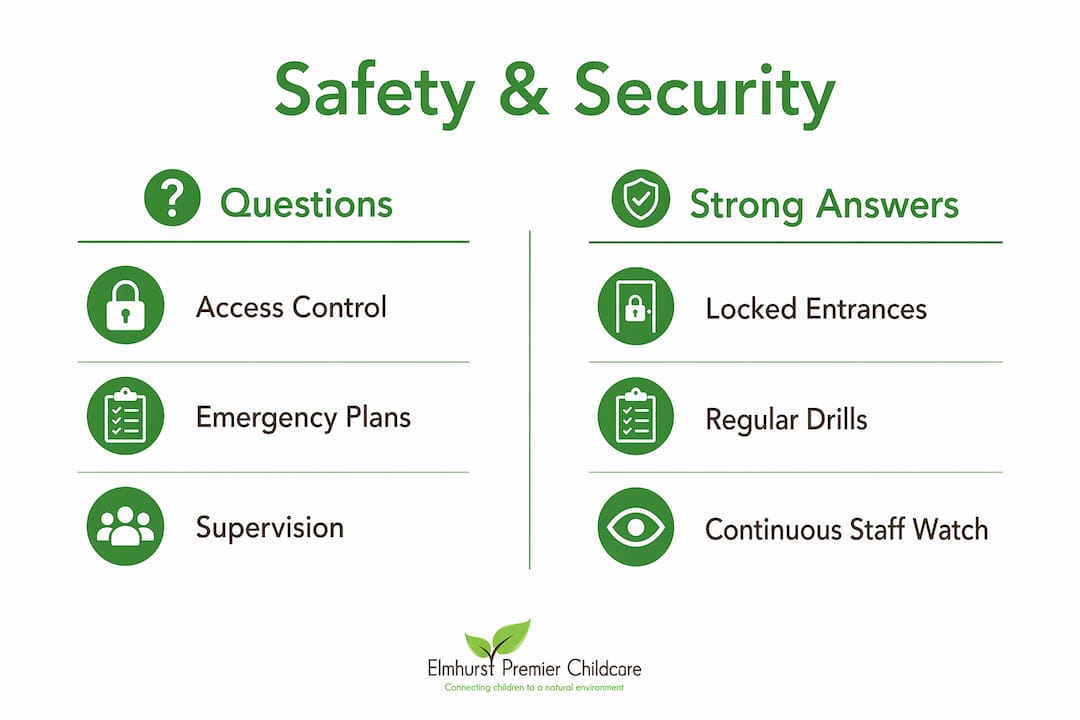
Safety questions reveal how seriously a center takes its responsibility. Vague answers here are a red flag, not a sign of modesty.
Start with drop-off and pick-up security. Ask how unauthorized pickups are handled and what documentation is required for anyone other than a parent to collect your child. A strong center has a written protocol, not a verbal policy.
- Emergency preparedness: Ask for specifics on evacuation plans, lockdown procedures, and how often drills are conducted. Effective emergency plans address local risks and mental well-being during and after emergencies, not just fire exits.
- CPR and first aid certification: Confirm staff training dates and verify that at least one certified person is on site at all times. An expired CPR card is not acceptable.
- Illness and injury policies: Ask exactly what happens when a child gets hurt or becomes sick during the day. Who calls you, how fast, and what documentation is created?
- Facility cleanliness: Observe during the tour. Clean bathrooms, sanitized surfaces, and organized classrooms signal daily standards, not just tour-day preparation.
The answers to these questions tell you whether safety is a culture or a checkbox at that center.
What staff qualifications and ratios should you ask about?
Staff quality is the single biggest predictor of your child’s experience. Ratios and credentials are where that quality shows up in measurable terms.

Ask for both the licensed teacher-to-child ratio and the actual staffing during transitions like arrival, nap time, and pickup. Licensed maximums and real-world staffing often differ. Transition periods are when supervision gaps are most likely to occur.
| Question | What a strong answer looks like |
|---|---|
| What is the teacher-to-child ratio? | Specific numbers below state maximums, confirmed in writing |
| What are your teacher qualifications? | Degree or credential in Early Childhood Education required |
| Do you conduct background checks? | Yes, on all staff before their first day |
| What is your teacher turnover rate? | Low turnover with lead teachers who have been there multiple years |
| Who covers when a teacher calls in sick? | Named substitute plan, not “we figure it out” |
Elmhurst Premier Childcare, for example, requires every educator to hold an early childhood degree or a Child Development Associate (CDA) or Certified Childcare Professional (CCP) credential. That standard goes beyond what Illinois state minimums require. When you ask about qualifications at any center, that is the bar worth comparing against.
Pro Tip: Watch how teachers interact with children during the tour, not just how they answer your questions. Do they get down to the child’s level? Do they use names? Behavior during a tour is behavior on a normal day.
What should you ask about daily routines and curriculum?
A center’s daily schedule reveals its educational philosophy more clearly than any brochure. Request a detailed walkthrough of a typical day including the balance of free play versus structured activities, outdoor time, and how developmental milestones are supported.
-
Ask about the curriculum. Is it play-based, academic, or a mix? Centers using research-based approaches like STEAM curriculum build creativity, critical thinking, and kindergarten readiness through hands-on activities. Ask for specific examples of what that looks like in a classroom.
-
Ask how milestones are handled. Potty training, room transitions, and language development all require intentional support. Ask who leads that process and how parents are kept informed.
-
Ask about meals and snacks. Find out whether food is provided or brought from home. If the center provides meals, ask about nutritional standards and how dietary restrictions or allergies are accommodated. Elmhurst Premier Childcare’s fresh meals program is one example of a center that treats nutrition as part of the curriculum, not an afterthought.
-
Ask about discipline. What is the center’s approach to behavior? Redirection, natural consequences, and positive reinforcement are developmentally appropriate. Punitive or isolating responses are not.
-
Ask about outdoor time. Children need daily outdoor play for physical development and stress regulation. Ask how much time is scheduled and what happens when weather limits it.
The answers to these questions tell you whether the center sees children as learners or as a group to manage until pickup.
How do you evaluate communication and policies during a daycare visit?
Communication quality predicts how well a center will partner with you over months and years. Two-way messaging and easy follow-up on incidents strengthen the parent-provider relationship in ways that matter when something goes wrong.
- Daily communication: Ask what platform or method the center uses to send updates. Apps, written reports, and in-person check-ins each have different strengths. The best systems are ones staff can maintain during a busy day and parents can actually understand.
- Incident documentation: Verify how incidents are documented and communicated and whether parents can follow up on behavior or health concerns after hours.
- Parent involvement: Ask whether parents can visit during the day and what formal involvement opportunities exist. Parent committees, family events, and open-door policies signal a center that values community.
- Tuition and fees: Clarify total costs upfront including registration fees, supply fees, late pickup charges, and vacation or absence policies. Surprises in billing erode trust fast.
- Concern resolution: Ask directly how the center handles a parent complaint. The answer reveals whether leadership is approachable or defensive.
Watch how staff respond to your questions during the tour itself. Responsiveness in that moment is a preview of responsiveness every day.
Key takeaways
A daycare visit checklist only works when paired with specific, direct questions across safety, staff, curriculum, communication, and policies.
| Point | Details |
|---|---|
| Tour during active hours | Mid-morning visits show real daily operations, not a staged environment. |
| Verify actual staffing ratios | Ask about transitions like arrival and nap time, not just licensed maximums. |
| Confirm CPR certification dates | At least one certified staff member must be present at all times. |
| Request a typical day walkthrough | Curriculum, outdoor time, and discipline philosophy all show up in the daily schedule. |
| Clarify all costs in writing | Registration fees, late pickup charges, and absence policies affect your total budget. |
What I’ve learned from watching parents tour daycares
The most revealing question a parent can ask on a tour is not “do you do X?” It is “show me how you do X.” That phrasing consistently produces more truthful and specific answers than open-ended questions that invite polished responses. Ask to see the emergency binder. Ask to watch a transition between activities. Ask to read a sample incident report. Centers with nothing to hide show you everything.
The biggest mistake I see parents make is accepting enthusiasm as evidence. A director who speaks passionately about child development is not the same as a center that delivers it. The gap between marketing and practice shows up in the details: whether the classroom is actually organized the way it was described, whether the teacher-to-child ratio holds during pickup, whether the communication app has real daily updates or generic check-ins.
Trust your instincts, but ground them in specifics. If something feels off and you cannot name why, go back for a second visit. Centers that are genuinely good welcome that. Centers that push you toward a quick enrollment decision are telling you something important.
— Kasindra
Elmhurst Premier Childcare: see the difference in person
Parents who use a thorough daycare evaluation guide often tell us the same thing after touring Elmhurst Premier Childcare: the answers here are specific, the classrooms match what was described, and the teachers know each child by name.
Elmhurst Premier Childcare offers personalized tours where you can observe the STEAM curriculum in action, meet the educators who will work with your child, and ask every question on your list. The preschool program and Pre-K program are built around research-based learning, qualified teachers, and transparent communication. Transparent pricing details are available online so there are no surprises. Book your tour and see firsthand what higher standards look like in practice.
FAQ
How long should a daycare tour take?
Plan for 45–60 minutes to observe classrooms, ask questions, and review key areas like outdoor spaces and bathrooms. Shorter tours rarely give you enough information to make a confident decision.
What is a good teacher-to-child ratio for toddlers?
State licensing sets maximum ratios, but the best centers staff below those limits. Ask for the actual ratio during transitions like arrival and nap time, not just the licensed maximum.
What questions should I ask about a daycare’s curriculum?
Ask for a walkthrough of a typical day, the educational philosophy behind it, and specific examples of how the curriculum supports kindergarten readiness. Centers using play-based or STEAM approaches should be able to show you examples, not just describe them.
How do I know if a daycare communicates well with parents?
Ask what platform or method is used for daily updates and how incidents are documented. Strong centers use two-way communication systems that allow parents to follow up on behavior or health concerns after hours.
What are red flags to watch for on a daycare tour?
Vague answers to safety questions, high staff turnover, reluctance to show you classrooms in use, and pressure to enroll quickly are all warning signs. A center confident in its quality welcomes thorough questions and repeat visits.