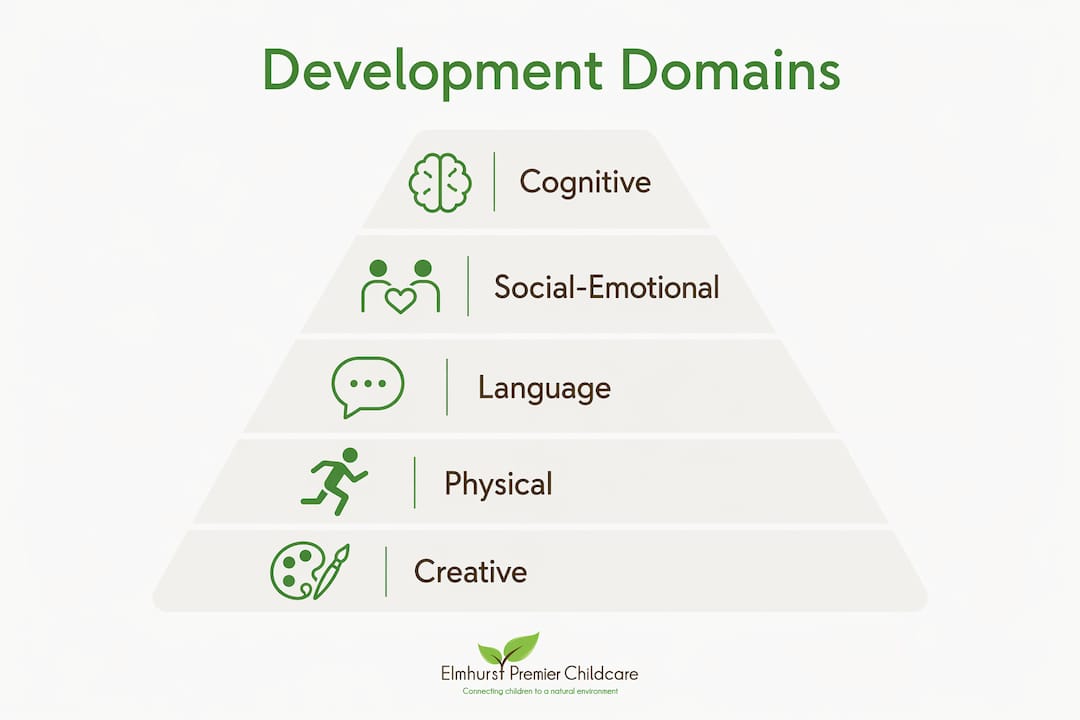
A preschool curriculum is a structured, research-backed program that guides children’s growth across five key developmental domains: cognitive, social-emotional, language, physical, and creative. Understanding how preschool curriculum develops children matters because the skills built between ages three and five form the foundation for every year of school that follows. The brain develops faster in the first five years than at any other point in life. A well-designed curriculum takes direct advantage of that window, not to push academics early, but to build the thinking, feeling, and communicating skills children need to thrive.
How does preschool curriculum develop children’s cognitive skills?
Cognitive development in preschool is about building reasoning, problem-solving, and the ability to focus on a task. A strong curriculum does not drill letters and numbers. Instead, it uses conceptual themes like “growth and change” or “how things move” to give children real problems to explore. That kind of conceptual depth over rote work leads to better kindergarten preparedness than early decoding practice alone.
Preschool learning activities that support cognitive growth include:
- Sorting and categorizing games that build logical thinking
- Building challenges with blocks or loose parts that develop spatial reasoning
- Science exploration stations where children make predictions and test them
- Thematic projects that connect ideas across multiple days of learning
Play-based curriculum strategies produce measurable improvements in reasoning, language, emotional intelligence, and cooperative behavior in children ages three to five. The combination of teacher-guided and child-led learning drives those gains. Neither approach works as well alone.
Effective curricula also build executive function, which includes skills like attention, impulse control, and working memory. These are the mental tools children use to sit in a circle, follow a two-step direction, and wait their turn. A teacher who asks open-ended questions during play, rather than just providing answers, extends a child’s thinking in ways that direct instruction cannot replicate.
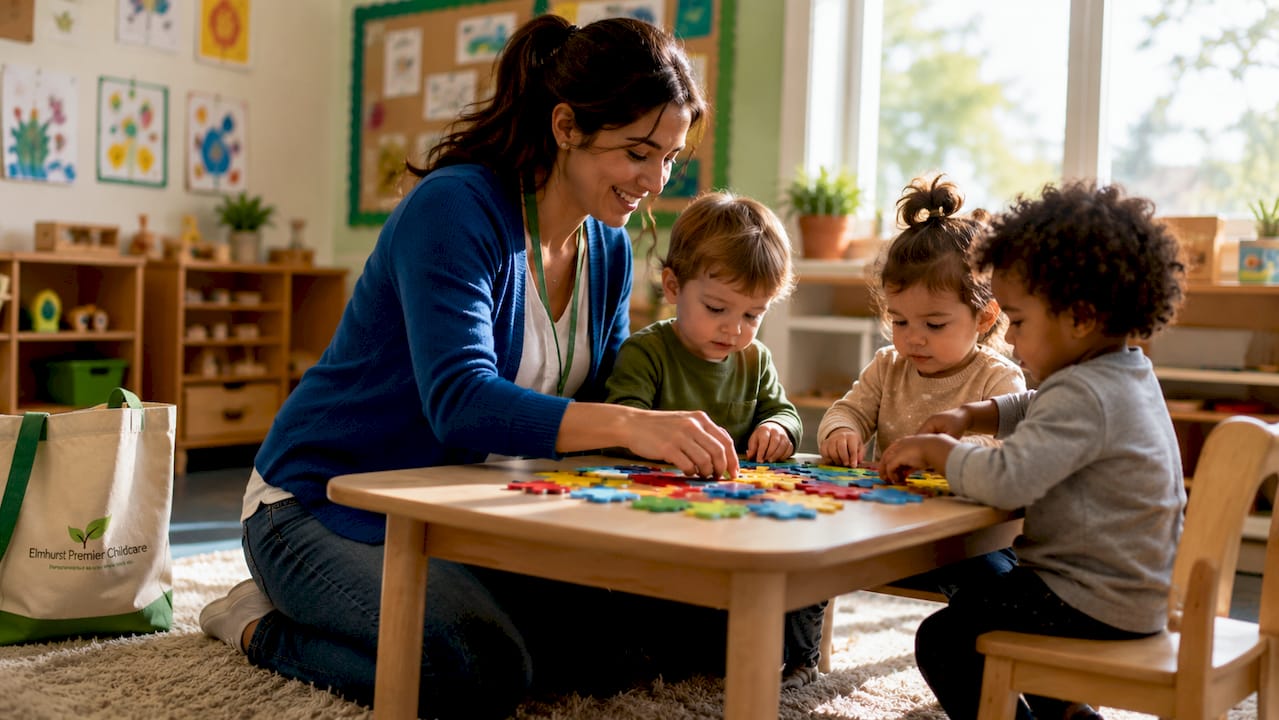
Pro Tip: Ask your child’s teacher what the current “big idea” or theme is in the classroom. If they can describe a conceptual thread running through the week’s activities, that is a strong sign the curriculum is building real thinking skills, not just filling time.
What role does curriculum play in social-emotional growth?
Social-emotional development is the domain parents most often underestimate, and it is the one that predicts kindergarten success most reliably. Non-cognitive skills like self-regulation and cooperative behavior are stronger predictors of school adjustment than early reading ability. A child who can manage frustration, share materials, and listen to a peer is ready for kindergarten in the way that actually matters to teachers.
A well-built curriculum addresses social-emotional growth through:
- Guided group activities that require turn-taking and shared decision-making
- Conflict resolution routines where teachers coach children through disagreements
- Emotion vocabulary work embedded in read-alouds and daily conversations
- Dramatic play centers where children practice perspective-taking naturally
Research confirms that high-quality early education produces lasting positive effects on emotional regulation and peer relationships from ages 3 to 11, with larger benefits for children from disadvantaged backgrounds. Those effects show up in reduced conduct problems and stronger peer relationships years after preschool ends. That is not a small outcome. It is the kind of development that shapes a child’s entire school experience.
“Preschool curriculum development focuses heavily on non-cognitive skills like self-regulation and cooperative behavior, which predict school success more than early literacy alone.” — New America, Choosing High-Quality Pre-K Curriculum
Self-regulation also connects directly to learning. A child who can calm themselves after a disappointment can return to a task. A child who can wait to speak can absorb what a teacher is explaining. Curriculum that builds these habits early gives children a real academic advantage, even before they read a single word.
How does preschool curriculum build language and communication?
Language development in preschool happens through rich, repeated exposure to words in meaningful contexts. Vocabulary, listening comprehension, and phonetic awareness all grow when curriculum intentionally weaves language into every part of the day. Effective preschool curricula integrate foundational academic skills like phonetic awareness through purposeful, play-based activities rather than worksheets or drills.
The most effective language-building activities in a preschool classroom include:
- Daily read-alouds with open-ended discussion questions that push children to predict, infer, and connect
- Conversation circles where every child practices speaking and listening in a structured setting
- Songs and rhymes that build phonemic awareness through rhythm and repetition
- Storytelling and retelling activities that develop narrative structure and sequencing skills
Increased participation in early childhood education narrows the reading achievement gap at primary school completion. Children who enter kindergarten with strong vocabulary and listening skills have a measurable head start in reading instruction. That gap, once established, is difficult to close.
The home environment amplifies what happens in the classroom. The home learning environment, including shared reading and number play, can sometimes outweigh socioeconomic status as a factor in child outcomes. Parents who read aloud daily and talk with their children about what they see and experience are extending the curriculum’s reach into every hour of the day.
Pro Tip: When reading with your child, pause and ask “What do you think will happen next?” or “Why do you think she felt that way?” Those two questions build inference skills that formal reading instruction builds on directly.
Physical and creative development in preschool curriculum
Physical development in preschool covers both gross motor skills, like running, jumping, and climbing, and fine motor skills, like holding a pencil, cutting with scissors, and manipulating small objects. Creative development covers art, music, and dramatic play. Both domains are often treated as extras, but they are core components of a complete curriculum.
| Domain | Curriculum Activities | School Readiness Connection |
|---|---|---|
| Gross motor | Outdoor play, movement games, yoga | Body regulation, attention, energy management |
| Fine motor | Drawing, cutting, clay, threading beads | Pencil grip, writing readiness, task persistence |
| Creative arts | Painting, collage, open-ended building | Self-expression, problem-solving, emotional processing |
| Music | Singing, rhythm instruments, movement | Phonemic awareness, listening, pattern recognition |
| Dramatic play | Dress-up, role play, puppet theater | Language, empathy, narrative thinking |
Music programs like Music Together connect rhythm and movement to early literacy in ways that are both measurable and genuinely enjoyable for young children. Creative play also supports emotional regulation. A child who works through a frustrating art project builds the same persistence muscle they will need when a math concept is hard.
Preschool learning plans that balance active and calm periods are not just managing energy. They are teaching children to shift between states of arousal, which is a foundational self-regulation skill. A curriculum that alternates between movement, focused work, and creative exploration is building the full range of skills children need.
How does preschool curriculum prepare children for kindergarten?
Kindergarten readiness is not about knowing the alphabet before the first day of school. It is about arriving with the attention, communication, and self-management skills that allow a child to learn in a group setting. High-quality preschool curriculum acts as a scaffold that allows educators to adapt learning experiences to each child’s developmental stage, rather than enforcing rigid milestone timelines.
The skills a strong curriculum builds for kindergarten readiness include:
- Self-regulation: the ability to manage emotions and impulses in a structured environment
- Attention and persistence: staying with a task long enough to complete it
- Foundational literacy: phonemic awareness, print concepts, and vocabulary
- Early math concepts: counting, patterns, spatial reasoning, and comparison
- Social competence: following group norms, cooperating, and resolving conflict
Kindergarten teachers consistently report that children who struggle most are not those who cannot read. They are children who cannot sit still, wait their turn, or manage a disappointment without a meltdown. A curriculum that addresses the full developmental picture, not just early academics, produces children who are genuinely ready for what school asks of them.
Readiness also looks different for every child. Curriculum serves as an essential scaffold that allows teachers to tailor experiences to diverse backgrounds and developmental needs. A child who is advanced in language but still developing fine motor skills needs a curriculum flexible enough to meet both realities at once.
Key Takeaways
A preschool curriculum that covers all five developmental domains produces children who are ready for kindergarten in the ways that matter most: emotionally regulated, socially competent, and curious.
| Point | Details |
|---|---|
| Cognitive growth requires depth | Conceptual themes and open-ended play build reasoning better than early drills or rote memorization. |
| Social-emotional skills predict success | Self-regulation and cooperation are stronger kindergarten readiness markers than early reading ability. |
| Language needs daily intentional practice | Read-alouds, conversation circles, and songs build vocabulary and phonemic awareness across every domain. |
| Physical and creative domains are not extras | Fine motor, gross motor, and creative play all connect directly to school readiness and emotional regulation. |
| Curriculum must flex for each child | High-quality programs scaffold learning to individual pacing rather than enforcing uniform milestone timelines. |
What parents miss most about preschool curriculum
Most parents walk into a preschool tour looking for evidence of academics. They want to see letters on the wall, counting charts, and children sitting at tables with pencils. I understand that instinct completely. It feels like proof that learning is happening.
The research tells a different story. The children who adjust best to kindergarten are the ones who learned to manage their emotions, work through conflict with a peer, and stay curious when something was hard. Those skills do not come from worksheets. They come from a curriculum that takes play seriously as a vehicle for real development.
What I find parents miss most is the non-linear nature of early childhood growth. A child who seems “behind” in one area in october may leap forward by january. A curriculum that allows for individual pacing, rather than pushing every child toward the same benchmark at the same time, is doing something genuinely sophisticated. It is not taking the easy road.
My advice: partner with your child’s teachers. Ask what they are observing, not just what your child is producing. Ask how the curriculum is being adapted for your child specifically. And look beyond reading and writing benchmarks. The child who can name their feelings, negotiate with a friend, and stick with a hard puzzle is building the foundation that every academic skill rests on. That is the real work of preschool.
— Kasindra
Discover Elmhurst Premier Childcare’s preschool programs
Elmhurst Premier Childcare’s preschool program is built on a hands-on STEAM curriculum that develops children across all five domains through play-based and teacher-guided experiences. Every educator holds an early childhood degree or a Child Development Associate (CDA) or Certified Childcare Professional (CCP) credential, going well beyond Illinois state minimums. Small group sizes mean teachers know each child’s strengths, pace, and personality.
The Pre-K program focuses specifically on kindergarten readiness through intentional scaffolding, individualized learning, and a community that keeps families informed and involved. If you want to see the curriculum in action, book a tour and meet the team that will know your child by name.
FAQ
What does a preschool curriculum actually include?
A preschool curriculum covers five developmental domains: cognitive, social-emotional, language, physical, and creative. It guides learning through a mix of play-based activities and intentional teacher instruction across all five areas.
Is play-based learning as effective as direct instruction in preschool?
Play-based and teacher-guided learning work best in combination. Research shows that combining both approaches produces measurable gains in reasoning, language, and cooperative behavior that neither method achieves alone.
What skills predict kindergarten readiness most reliably?
Self-regulation, attention, and social competence predict kindergarten success more reliably than early reading or writing ability. Children who can manage emotions and cooperate with peers adjust to kindergarten far more smoothly than those who cannot.
How can parents support the preschool curriculum at home?
Shared reading, number play, and open-ended conversation at home directly extend what children learn in the classroom. The home learning environment can outweigh socioeconomic factors in shaping child outcomes when parents engage consistently.
How do I know if my child’s preschool curriculum is high quality?
Look for a curriculum that adapts to individual children rather than enforcing uniform timelines, balances play with intentional teaching, and addresses social-emotional development alongside early academics. Ask teachers how they scaffold learning for your child specifically.